
Tag: Episode 3

  • Education Insight: Positive and Negative Impacts of AI in Local Education and Economy

    Education Insight: Positive and Negative Impacts of AI in Local Education and Economy

    About This Episode

    Season 3. Episode 3.

    Artificial Intelligence has landed in the Inland Empire; allowing high school students to explore Egypt or China in virtual reality. It is helping pre-med students learn surgery with overlay vision that shows them where to make incisions and it’s making local logistic hubs more efficient. But two top experts in Inland economics and education are warning that it comes with a price. Instructors at all grade levels worry that chat gpt is actually completing your child’s school report, and Amazon is talking about creating “dark warehouses,” where all employees are let go, robotic devices take over the heavy lifting and they can save even more by turning off all of the lights. Are we prepared for all of this?

    On today’s Education Insight, we focus on nothing but A.I. and our region. This story is one where local politicians and educators are working to save the future and our jobs by getting in front of Artificial Intelligence. Dr. Johannes Moenius, from the University of Redlands, is an internationally respected expert on global economics and technology who has focused much of his work and teachings on the Inland Empire. Dr. Christian Shelton; A faculty member in the Computer Science & Engineering department at the University of California Riverside, and Author or co-author of over 65 scholarly works on Artificial Intelligence dating back to 2006. He is the lead contributor and member of R-Lair; a Riverside California lab of scholars all dedicated to research on artificial intelligence. I hope you’ll join us for the next Education Insight when we explore: A.I. in the I.E.


    Featured Guests

    Dr. Christian Shelton

    Professor, Computer Science & Engineering, UCR.

    Dr. Shelton is a Professor of Computer Science at the University of California at Riverside and a member of UCR’s Data Science Center. He has been on the faculty since 2003. His research interests are in statistical approaches in artificial intelligence, with a focus on machine learning and dynamic systems. He has applied his work to areas ranging from astronomy to sociology to medical informatics.

    Dr. Shelton received his B.S. in Computer Science from Stanford University in 1996. He then obtained his Ph.D. from MIT in 2001 and returned to Stanford from 2001 to 2003 as a post-doctoral scholar. He spent six months in 2003 and 2004 as a visiting faculty member at Intel Research and the 2012-13 academic year as a visiting researcher at Children’s Hospital Los Angeles. He has been the Managing Editor of the Journal of Machine Learning Research and on the Editorial Board of the Journal of Artificial Intelligence Research; he currently serves on the Editorial Board for the Journal of Machine Learning Research.

    Dr. Shelton is a member of Tau Beta Pi (the national engineering honor society) and Phi Beta Kappa (the national liberal arts and sciences honor society). He received the Young Investigator Award from the Air Force Office of Scientific Research and was a member of DARPA’s Computer Science Study Group.

     Dr. Johannes Moenius

    Professor, William R. and S. Sue Johnson Endowed Chair of Spatial Economic Analysis and Regional Planning School of Business & Society

    Johannes Moenius teaches global business at the University of Redlands. He is the founding director of the Institute for Spatial Economic Analysis (ISEA) and holds the William R. and S. Sue Johnson Endowed Chair of Spatial Economic Analysis and Regional Planning. Previously, he taught at the Kellogg School of Management and was a visiting scholar at Tokyo University. His research appeared, amongst others, in The Review of Economics and StatisticsJapan and the World Economy, and the International Journal of Industrial Organization. His recent work on automation and the workforce has been covered by the Atlantic, PBS Newshour, NPR, FastCompany, Business Insider, the Washington Post and many other news media worldwide. He has presented his work in more than 200 talks at universities, conferences, and government institutions.

    Interview Highlights

    3:54 – Dr. Shelton describes some of the ways AI is already being used today

    13:11 – Dr. Shelton is asked if we should be rethinking education in general so our students are properly prepared for job security

    16:35 – Dr. Shelton shares what he finds particularly promising as far as the uses of AI in education

    18:15 – Dr. Shelton reflects on the ultimate impact of AI on our region in the next 5 years

    20:40 – Dr. Shelton shares a message to local legislators about what they should be doing to assist educators and industry to help keep the IE economically productive

    22:40 – Dr. Shelton explains why he believes our area will be able to adapt to a large influx of AI

    26:42 – Dr. Moenius describes what changes will the Inland Empire face as more Artificial Intelligence arrives

    32:08 – Dr. Moenius  talks about what schools need to be teaching right now to help prepare students for the future

    37:05 – Dr. Moenius gives insight into whether or not the new jobs that might use A.I. are going to require workers to upgrade their skills and get a college degree

    42:56 – Dr. Moenius explains what local legislators need to be working on right now

    46:45 – Dr. Moenius shares what jobs are likely to be affected when AI inevitably makes its way into most industries

    View our podcast page for more stories like this: https://gia.echofactory.dev/gia-podcasts/

    Education Insight tells the story of education in the Inland Empire through the diverse voices of those in and around the regional education community. The show is produced by Growing Inland Achievement, a collective impact organization in the Inland Empire with a mission to increase economic prosperity in the region by increasing educational attainment. Hosted by 30-year broadcast veteran Lacey Kendall, monthly shows explore topics ranging from education challenges and shortcomings to innovations and groundbreaking ideas that are driving student success.
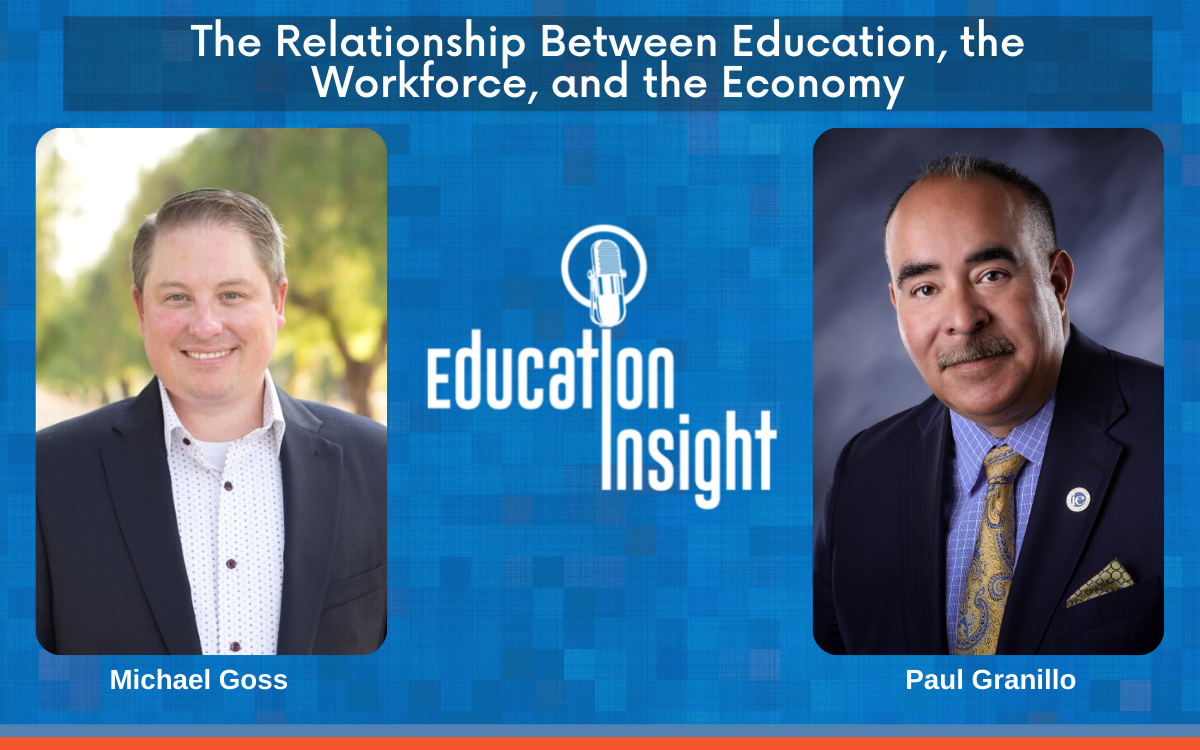
  • Education Insight: The Relationship Between Education, the Workforce, and the Economy

    Education Insight: The Relationship Between Education, the Workforce, and the Economy

    About This Episode

    Season 2. Episode 3.

    In the 1970s and 80s, traditionalist educators insisted that a great education should include lots of structure, specific standards of performance, and a heavy dose of memorization of key facts and concepts. These they assured, would help our students to enter the workforce already proficient in language and writing skills, mathematics, science, social studies, and some critical thinking. Are those skills enough for an IE student to succeed in the current and coming workforce? What do students in the Inland Empire need to know today? Are our schools preparing graduates with what they really need to know and preparing our community with upcoming graduates ready to take local businesses and industry into a brighter future? Find out in today’s episode.

    Featured Guests

    Michael Goss

    Director of the Inland Empire/Desert Center of Excellence for Labor Market Research

    Kevin McCarty was elected to the California State Assembly in 2014 to represent the 7th Assembly District, which includes Sacramento, West Sacramento and parts of unincorporated Sacramento County.

    McCarty serves as Chair of the Assembly Budget Subcommittee on Education Finance, which oversees the largest component of California’s multi-billion dollar budget. As Chair, McCarty made historic investments in public education including expanding access to preschool for low and middle income families, providing greater career technical education programs, and increasing student enrollment at our public colleges and universities.

    Other legislative priorities for Assemblymember McCarty include addressing housing affordability, fighting climate change, championing criminal justice reform, curbing gun violence, tackling the opioid crisis and advocating for the middle class.

    McCarty began his public service career as a Sacramento Housing and Redevelopment Commissioner and served on the Sacramento City Council from 2004 to 2014. As a Councilmember, he created innovative youth programs and wrote common-sense gun laws, tackled sub-standard rental housing, and crafted clean air policies. He created Sacramento’s Little Saigon district, the City’s Whistleblower Hotline program, and the Independent Auditor department.

    A lifelong Sacramentan, McCarty went to local public schools, attended American River College, earned a Bachelor’s degree in Political Science from CSU Long Beach and a Master’s degree in Public Policy and Administration from CSU Sacramento.

    McCarty and his wife live in the Elmhurst neighborhood of Sacramento with their twin daughters.

    Like, follow and connect with Assemblymember McCarty on Facebook, Twitter & Instagram: @AsmKevinMcCarty

    Paul Granillo

    President & CEO, Inland Empire Economic Partnership (IEEP)

    Karen Scott is the Executive Director of the Children and Families Commission – First 5 San Bernardino, a funding organization of services for children prenatal through age 5, by investing revenue received from Prop 10, a tobacco tax initiative in California.

    Ms. Scott’s education and background is in Public Administration and Administration of Justice and she has worked in the realm of Human Services for San Bernardino County since 1977.  Karen has served as Executive Director of First 5 San Bernardino for 14 years leading the organization’s efforts to promote, support and enhance the health and early development of children, prenatal through age five through coordinated and comprehensive systems of care that strengthen children, families and communities, ensuring children are safe, healthy and ready to enter and succeed in school.

    Karen is married to James Scott and has 4 adult children and 4 grandchildren.

    Interview Highlights

    8:17 – Michael shares the most in-demand careers right now and in the future for the Inland Empire

    10:15 – Michael describes how the Inland Empire is doing as a region in keeping up with workforce demand

    13:02 – Michael discusses particular industries that he believes are economically critical to the Inland Empire

    14:20 – Michael details what we can do as a region to be more competitive going forward

    15:12 – Michael talks about some of the most significant challenges that we’re facing in regards to training and meeting the needs of businesses in the region.

    18:28 – Michael gives insight into how COVID-19 has changed the workforce in the Inland Empire

    23:16 – Paul shares the greatest challenges facing the Inland Empire today

    25:36 – Paul describes how the Inland Empire is doing when it comes to training and education of a workforce to meet the needs of employers

    26:40 – Paul reflects on the lessons we’ve learned about our local economy as a result of the pandemic.

    30:34 – Paul explains what he believes is needed from our workforce and our local educational institutions to create a more vibrant regional economy.

    34:37 – Paul shares whether or not he believes education is necessary to earn a living wage in our region

    38:46 – Paul discusses whether or not more college graduates = more businesses in the Inland Empire

    46:08 – Special Feature Original Song: Romeo by: Micha Justice

    View our podcast page for more stories like this: https://gia.echofactory.dev/gia-podcasts/

    Education Insight tells the story of education in the Inland Empire through the diverse voices of those in and around the regional education community. The show is produced by Growing Inland Achievement, a collective impact organization in the Inland Empire with a mission to increase economic prosperity in the region by increasing educational attainment. Hosted by 30-year broadcast veteran Lacey Kendall, monthly shows explore topics ranging from education challenges and shortcomings to innovations and groundbreaking ideas that are driving student success.

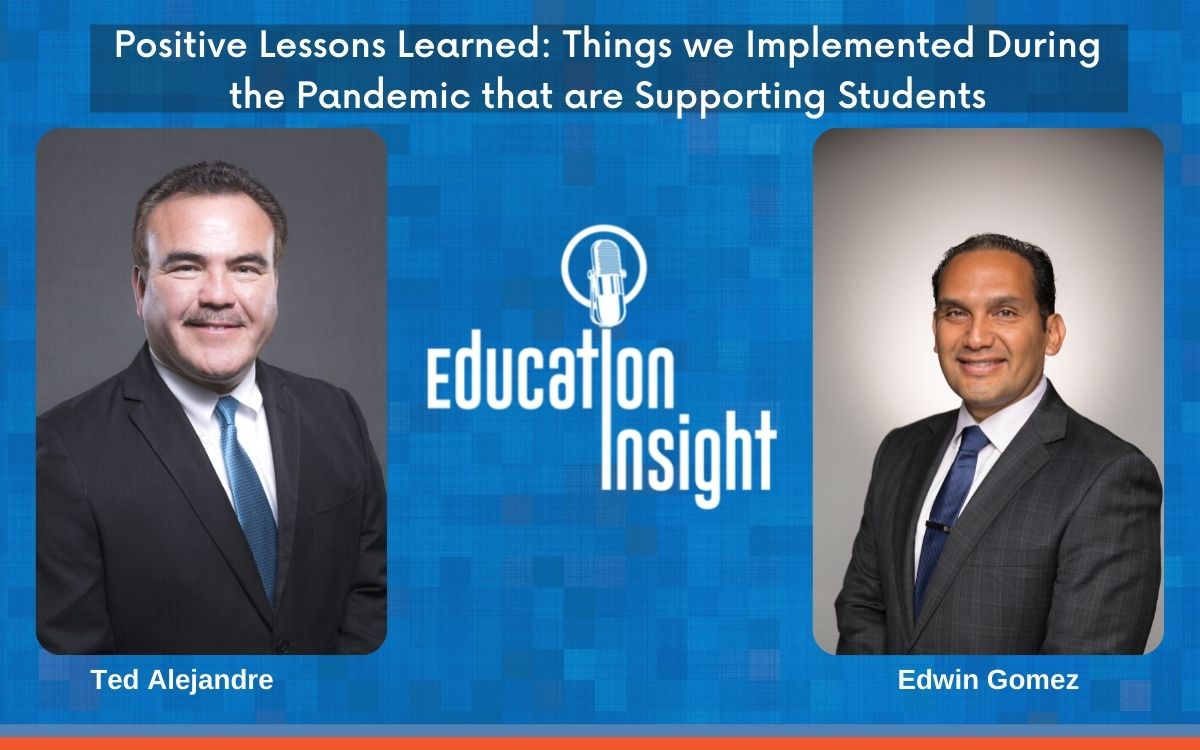
  • Education Insight: Positive Lessons Learned: Things we Implemented During the Pandemic that are Supporting Students

    Education Insight: Positive Lessons Learned: Things we Implemented During the Pandemic that are Supporting Students

    About This Episode

    Season 1. Episode 3.

    Taking our education system entirely online within a month would have seemed to be an impossible task before the pandemic. Yet, schools across the region made it happen to ensure learning continued despite the challenges faced during the crisis.

    Many of us were surprised at the things we learned. Now, with a glimmer of normalcy on the horizon, and state and national resources dedicated to accelerating out of the pandemic, what are the positive takeaways from this experience? Join us for a discussion with three special guests about using lessons learned to improve student access and success.

    Featured Guests

    Ted Alejandre

    San Bernardino County Superintendent of Schools.

    Emma Diaz has more than 30 years of experience in the fields of healthcare and education. She is currently the Director for the Inland Adult Education Consortium at San Bernardino Valley College, where she manages the implementation of the California Adult Education Program (CAEP) legislation. As Director she has played a leadership role in creating and expanding educational programs across the region for underserved, often marginalized populations in adult education.

    Emma participates regularly on state level advisory groups, presents at regional, state and national conferences, and is an international lecturer. She strategically positioned the Inland Adult Education Consortium as the professional development center for the Inland Empire, partnering with both state and national organizations. Most recently hosting the 2nd Annual Google Summit for Adult Education.

    In addition to her current role as Consortium Director, she teaches for both credit and noncredit programs at multiple community colleges. She is currently a Board Member of the Association of Continuing and Community Education and is on the Basic Skills and Noncredit Committee for the Academic Senate for California Community Colleges. She earned her Ed.D. in Educational Leadership from the University of Southern California, holds a master’s degree in Healthcare Administration and a bachelor’s in Business Administration from California State University, Northridge.

    Edwin Gomez

    Riverside County Superintendent of Schools.

    Annette Webb, M.Ed., is the Associate Dean of Academic Affairs at the University of California Riverside, University Extension. In her role, Annette upholds University Extension’s preeminent status in the professional, online, and continuing studies realm by evaluating and successfully responding to the educational needs of non-traditional learners, both domestic and international. She provides leadership in curricular and instructional areas, strategic planning, partnership engagement, student success, academic quality, and financial management.

    Annette is a product of the California Master Plan for Higher Education, beginning her educational journey at Crafton Hills Community College then transferring to California State University, San Bernardino to earn a Bachelor’s degree in Business Administration. She went on to complete a Master’s degree in Education with an emphasis on Higher Education Leadership and Policy from UC Riverside.

    She is a member of Growing Inland Achievement’s Returning Adult Action Network Team and she is the inaugural Co-Chair and Staff Representative for the Chancellor’s Advisory Committee on the Status of Women at UCR. Annette is a proponent for life-long learning and is a higher education professional who represents excellence, accountability, integrity, and respect.

    Interview Highlights

    4:14 – Ted explains how San Bernardino County is geographically very diverse which sometimes complicates the struggle to keep kids learning.

    6:36 – Ted describes what was done by the district to ensure that learning continued even amidst unprecedented learning conditions.

    13:25 – Ted reveals that many administrators including himself, have learned valuable lessons that might actually make local schools better in the long run.

    15:14 – Ted discusses how his district has offered support for mental health issues when it comes to students.

    19:27 – Ted shares how the pandemic has changed the way he views K-12 education in the Inland Empire.

    21:33 – Edwin reveals where his office had made the greatest changes for Riverside County schools.

    24:40 – Edwin shares what he found to be the most difficult thing that his team in the superintendent’s office had to address.

    30:03 – Edwin talks about new projects, initiatives, that have started as a result of the pandemic.

    35:45 – Edwin shares his concerns for the students that lost their senior year of high school and what his office is doing to address their struggles.

    42:40 – Special Feature: Richard Edwards

    View our podcast page for more stories like this: https://gia.echofactory.dev/gia-podcasts/

    Education Insight tells the story of education in the Inland Empire through the diverse voices of those in and around the regional education community. The show is produced by Growing Inland Achievement, a collective impact organization in the Inland Empire with a mission to increase economic prosperity in the region by increasing educational attainment. Hosted by 30-year broadcast veteran Lacey Kendall, monthly shows explore topics ranging from education challenges and shortcomings to innovations and groundbreaking ideas that are driving student success.