Category: News

  • Inland Empire Guided Pathways Student Voice

    Inland Empire Guided Pathways Student Voice

    Student-generated solutions are a critical component of equitable institutional transformation. GIA has undertaken numerous student voice research studies using an innovative multimodal cognitive method designed by Dr. Yvonne Olivares, which are generating valuable insights and actionable recommendations. We encourage you to take some time to explore and act on the insights found  below.

    Student Voice Research Findings and Recommendations by Topic Area

    TECHNOLOGY
    • Many students do not own “their own” laptops (they share or borrow)
    • There is no single-best communication mode for all students, not even a single-best mode for any given student all the time
    • College office hrs. overlap students’ work hrs
    Student Recommendation GP Pillars Student Success Factors
    (RP Group)
    Potential Campus Partners
    Allow for multiple modes of communication
    •Video chat with file & screen sharing function
    •Call-in option
    •Email for simple questions
    •Instant messaging
    Entering the Path
    Staying on the Path
    Connected All
    Create and include step-by-step tutorials on how to access any student service and including technology needed (app, OS, browser) Entering the Path
    Staying on the Path
    Connected All


    ACCESS TO INFORMATION
    • Even students with laptops rely heavily on mobile due to conflicting demands; mobile is primary
    • Although information is available online, information is difficult to find
    • Students miss appointments due to wrong app and/or incompatible browsers and as a result are often blocked from scheduling additional appointments

    Student Recommendation GP Pillars Student Success Factors
    (RP Group)
    Potential Campus Partners
    User-friendly websites optimized for mobile Entering the Path
    Staying on the Path
    Directed
    Focused
    All
    College mobile app that allows students to search for the information and resources they need Entering the Path
    Staying on the Path
    Directed
    Focused
    All
    Consistent software and apps across the college to create more consistent online services experience Entering the Path
    Staying on the Path
    Directed
    Focused
    All
    Guidance on using/saving multiple passwords Entering the Path
    Staying on the Path
    Directed
    Focused
    All


    COUNSELING
    • Students who know their major in advance of seeing a counselor are more likely to report a positive experience
    • Poor experiences often stem from students not being given or not understanding how to access resources mentioned by counselor (Students are unable to recall info after meeting and do not know how to access counselor notes in apps like Starfish)

    Student Recommendation GP Pillars Student Success Factors
    (RP Group)
    Potential Campus Partners
    Have counselor recommendations documented where students can readily review Entering the Path
    Staying on the Path
    Directed
    Focused
    Counselors
    Provide more detailed guidance on how to access additional resources such as Major Requirement sheets Entering the Path
    Staying on the Path
    Directed
    Focused
    Counselors
    Allow for advance scheduling Entering the Path
    Staying on the Path
    Directed
    Focused
    Counselors
    Have more evening and weekend appointments Entering the Path
    Staying on the Path
    Directed
    Focused
    Counselors


    ONLINE LEARNING
    • Students with luxury of time/tech waste time navigating the differently designed courses
    • Those without time/tech miss resources/assignments becasue they cannot find them

    Student Recommendation GP Pillars Student Success Factors
    (RP Group)
    Potential Campus Partners
    Create standards and templates for instructors to follow that provide consistency across courses Staying on the Path
    Ensuring Learning
    Directed
    Focused
    Department Chairs/Deans
    Canvas notifications for:
    •New assignments posted
    •Assignment is coming due
    •Zoom meeting (with link and password)
    •Group messages
    •Any other relevant course information
    Staying on the Path
    Ensuring Learning
    Directed
    Focused
    Instructors
    Consistent notifications across courses/interfaces Staying on the Path
    Ensuring Learning
    Directed
    Focused
    Instructors
    Zoom meetings should have new announcement with link EVERY TIME Staying on the Path
    Ensuring Learning
    Directed
    Focused
    Instructors
    Instructor office hours should be posted in online environment Staying on the Path
    Ensuring Learning
    Directed
    Focused
    Instructors


    CAREER EXPLORATION
    • Students base major/career decision on limited information
    • Students rely on google/youtube on hot/top/popular jobs
    • Many students are not aware of their suitability (e.g., personality fit, skills) or feel pressured to begin earning immediately
    • Students want to both be able to find major/career information themselves (self-guided) and have access to guided support

    Student Recommendation GP Pillars Student Success Factors
    (RP Group)
    Potential Campus Partners
    Guided: Provide more opportunities for career exploration. Entering the Path Directed
    Focused
    Career Services
    Guided: Mandatory counseling 2-3 times per semester Entering the Path Directed
    Focused
    Counselors
    Guided: Counselors specializing in major/career fields Entering the Path Directed
    Focused
    Counselors
    Career Services
    Guided: GenEd courses support increasing knowledge of career options Entering the Path Directed
    Focused
    Instructors
    Career Services
    Guided: Internships Entering the Path Directed
    Focused
    Career Services
    Guided: Broaden career assessment to include:
    •Skills analysis
    •Hobbies/interest
    •Personality
    •Job market
    Entering the Path Directed
    Focused
    Career Services
    Self-Guided: Increase self-guided career information and assessment with website, app, and Canvas career information that includes:
    •Major/career requirements
    •Potential careers they can pursue with the major/career
    •Skills students can expect to develop in major/career
    •Pertinent personality requirements for major/career
    •Major /career-based student groups
    •Workshops and seminars specific to field of study
    Entering the Path Directed
    Focused
    Career Services
    Self-Guided: Host an annual major/career fair Entering the Path Directed
    Focused
    Career Services
    Self-Guided: Provide opportunities for students to hear professional speakers Entering the Path Directed
    Focused
    Career Services
    Self-Guided: Require students to attend activities that teach about campus opportunities and support systems Entering the Path Directed
    Focused
    Career Services


    STUDENT ENGAGEMENT
    • Students feel left out/isolated and do not have regular groups or activities on their campuses
    • Students rely on external groups for creating a sense of belonging
    • Campus activities limited to annual or special events

    Student Recommendation GP Pillars Student Success Factors
    (RP Group)
    Potential Campus Partners
    Utilize communication tools such as
    •Weekly email
    •Regularly updated webpage
    •College-specific app
    •Canvas links
    to offer broader outreach about information on groups, events and activities were happening around campus and HOW to participate
    Staying on the Path Nurtured
    Engaged
    Connected
    All
    Create and offer student groups that are topic- or group- specific including:
    •Ethnicity-based, service oriented: to provide support and geared toward serving a greater purpose (i.e. service-related or volunteer org)
    •Professional: related to courses, major, and/or career
    – Direct such as business, medical
    – Indirect such as writing groups
    •Personal interests such as  bowling, basketball, dating, poetry
    •Mental health: professional or peer to peer to talk with others about their struggles during COVID-19 (students open to digital i.e. chat rooms)
    Staying on the Path Nurtured
    Engaged
    Connected
    All
    Spotlights on fellow Black/African American students and their accomplishments as a reminder they are not alone. Staying on the Path Nurtured
    Engaged
    Connected
    All

    CAMPUS STATE
    • Students are differentially impacted by pandemic (e.g. female Latinx students more likely to report un/underemployment)
    • Students lack awareness that “support” is possible
    • New pandemic-specific responsibilities (e.g., managing children’s online education and their own simultaneously) are extremely difficult
    • College office hours conflict students’ work hours

    Student Recommendation GP Pillars Student Success Factors
    (RP Group)
    Potential Campus Partners
    Look for ways to offer “support” proactively (rather than waiting for students to ask) AND avoid using term “help” as many highest need students  are uncomfortable with the term Entering the Path
    Staying on the Path
    Connected
    Focused
    All
    Provide mental health professionals or peer-to-peer to talk about their struggles exasperbated by COVID-19 Entering the Path
    Staying on the Path
    Connected
    Focused
    Student Services
    Create positive experiences for students that normalize support-seeking behavior by providing caring, consistent, reliable, and easy-to-use support Entering the Path
    Staying on the Path
    Connected
    Focused
    All
    Continue all possible online service option post-pandemic Entering the Path
    Staying on the Path
    Connected
    Focused
    All
    Provide professional development for all campus constituents to maximize the functionality of technology (i.e. Zoom, Canvas…) Entering the Path
    Staying on the Path
    Connected
    Focused
    Professional Development Committee
  • Emergency Grants Announced by Growing Inland Achievement

    Emergency Grants Announced by Growing Inland Achievement

    In a coordinated regional response to Inland Empire student needs, Growing Inland Achievement (GIA) has distributed 14 grants to local programs and nonprofit organizations, totaling $255,000. The funds will be used to support students in the Inland Empire with technology, basic needs, and college transition.

    With support from the emergency funding, these organizations can continue to provide services to students in the community affected by the pandemic. “We want to thank all of those who applied and congratulate the award recipients who are empowering students to reach their educational goals during these challenging times,” said Growing Inland Achievement CEO Carlos Ayala.

    Grant recipients include:

    • BLU Educational Foundation – $30,000
    • OneFuture Coachella Valley – $30,000
    • California State University, San Bernardino Office of Pre-College Programs / San Bernardino County Superintendent of Schools / San Bernardino Community College District – $30,000
    • Riverside County Office of Education – $25,000
    • Ontario-Montclair Promise Scholars – $25,000
    • Great Harvest Community Center – $25,000
    • University of California, Riverside – $15,000
    • San Bernardino Valley College Foundation – $15,000
    • Norco College – $10,000
    • Jurupa Valley Unified School District – $10,000
    • Coachella Valley Unified School District – $10,000
    • Crafton Hills College – $10,000
    • California State University, San Bernardino Philanthropic Foundation – $10,000
    • Moreno Valley College UMOJA Program – $10,000

    Growing Inland Achievement is a regional collective impact organization aimed at increasing postsecondary credential attainment, adding more qualified people to the workforce, and contributing to a thriving economy. To contact GIA please email info@gia.echofactory.dev.

  • Inland Empire Adult and Professional Education Programs Gets Boost from Bank of America

    Inland Empire Adult and Professional Education Programs Gets Boost from Bank of America

    Growing Inland Achievement (GIA), a regional collective impact organization seeking to improve the Inland Empire economy by increasing regional levels of degree attainment, has received a $25,000 grant from Bank of America to support adult and professional education in the Inland Empire.

    GIA facilitates collaboration among regional stakeholders to identify and implement measurable strategies to create institutional change and increase regional educational attainment levels.

    “This generous grant from Bank of America will support GIA’s initiatives to bring together regional leaders to examine viable strategies and review institutional opportunities, alleviating barriers to college education for adult learners,” said Dr. Carlos Ayala, CEO at GIA. “We are very grateful for Bank of America’s commitment to advancing the Inland Empire and improving the quality of life for our residents, especially during these unprecedented times.”

    Families in the Inland Empire struggle with generational poverty and the ability to earn a living wage as a result of low postsecondary education attainment rates. Although the Inland Empire is the most populous region in California, adults here are less likely to pursue higher education than in other areas of the state, and many of those who do enroll in college are not able to finish their education.

    “There is a direct correlation between educational achievement and income, and tackling the Inland Empire’s education gap is key creating sustainable financial stability in the region. The strategic work of Growing Inland Achievement will be even more important following the crisis to prepare adults with the education and skills training for potential new professions,” said Al Arguello, Inland Empire market president, Bank of America.

    “Nearly one in four adults in the Inland Empire has some college attainment but has not completed a degree,” said Sorrel Stielstra, Director of Research at GIA. “We need to open doors for these individuals to return to school, earn postsecondary credentials, thrive in the workforce, and contribute to our regional economy.”

    GIA tracks regional data on educational attainment and its link to the labor market in the region. On average, individuals in the Inland Empire who have earned a Bachelor’s degree earn approximately $24,000 more annually than those with just a high school degree. GIA has plans to host a series of data workshops in the fall to explore the regional alignment between educational and occupational pathways, which may help to inform decision-making in response to the effects of the global pandemic on the region.

    A portion of grant funds from Bank of America will support efforts to identify and recruit key community members to serve on an adult and professional education Action Network Team and accomplish three goals:

    1)    Identify specific areas of support needed for adult learners to return to and/or complete their education;

    2)    Identify realistic implementation strategies;

    3)    Create a data collection and measurement process to measure impact and inform policy.

    Action Network Teams are the backbone of GIA’s collective impact model and bring together the Inland Empire higher education network, regional educators that combine expertise to work toward a vision of student success. 

    Growing Inland Achievement is a bi-county, collective impact intermediary in the Inland Empire that brings together leaders across K-20 education, civic, and business sectors. GIA organizes and collaborates with the Inland Empire Educational Network to create innovative practices that achieve large-scale social and institutional change. Visit our website, inlandempiregia.org, to learn more.


  • GIA Grant Funding Available to Support Inland Empire Students

    GIA Grant Funding Available to Support Inland Empire Students

    Grant Funding Available to Support Inland Empire Students

    COVID-19 Emergency Funding of up to $50,000 and Innovation Awards Funding of $150,000 Available for Educational Organizations Supporting Inland Empire Students

    Growing Inland Achievement (GIA), an educational intermediary organization seeking to improve the Inland Empire economy by raising the region’s educational attainment rates, has announced that COVID-19 Emergency Funding is now available for educational organizations supporting critical student needs amidst COVID-19. Organizations may apply for up to $50,000 in funding from now through April 21. Additionally, GIA has extended the application deadline for their $150,000 Innovation Awards to April 30.

    School closures and economic shutdowns due to the global pandemic have created educational and financial challenges for Inland Empire students and institutions. GIA created the COVID-19 emergency fund to assist with immediate challenges the coronavirus pandemic will present for students in the next 3-9 months.

    “The regional effect of the coronavirus requires us to focus on the educational and economic challenges of the present moment to continue the pursuit of the network’s shared vision,” said Ann Marie Sakrekoff, Senior Director at GIA. “After many conversations with our educational partners throughout the region, we have identified three focus areas for the emergency grant funding including; student basic needs support, class of 2020 college transition support, and technology assistance.”

    Awardees of emergency funding will be informed of approval and have funding distributed by May 4, 2020.

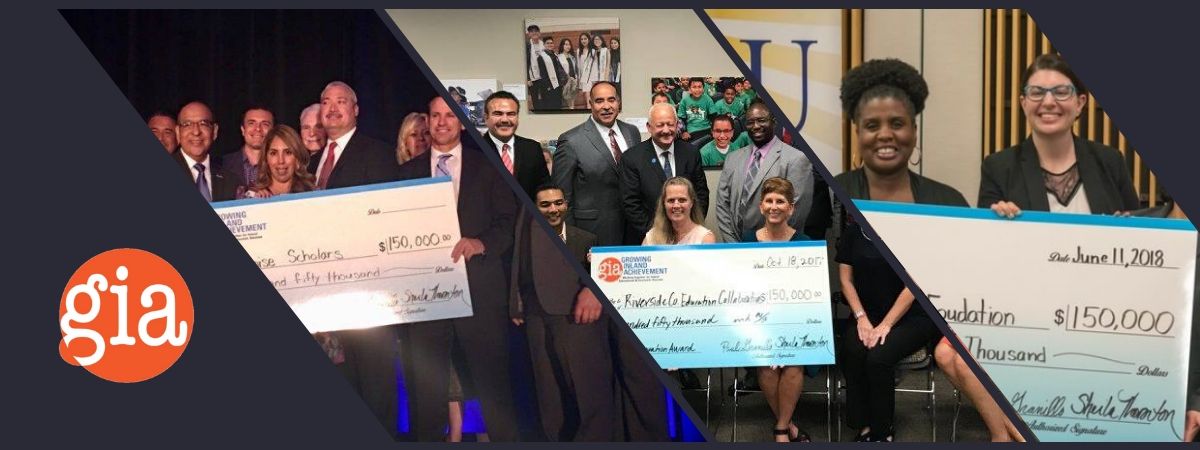
    In addition to the COVID-19 emergency funding, GIA will continue with their Innovation Awards which awards grants of $150,000 to organizations working towards accomplishing one or more of five measurable goals:

    • Align educational policy initiatives regionally via cradle-to-career collective impact model.
    • Increase college preparedness, particularly in math, resulting in a 20% reduction in the number of students requiring remediation at matriculation from high school to college within five years. 
    • Increase baccalaureate, associate, certificate, and credential attainment by 15% across the two counties within five years. 
    • Increase the six-year graduation rate by 10% over five years.
    • Improve career preparedness through strengthened partnership with industry to better align education with workforce development needs. 

    Applications for Innovation Awards are due by April 30 and funding is dispersed in two parts to grantee organizations in June 2020 and May 2021.   

    Growing Inland Achievement is a bi-county, educational collaborative in the Inland Empire that brings together leaders across K-20 education, civic, and business sectors. GIA organizes and collaborates with the Inland Empire Educational Network to create innovative practices that achieve large-scale social and institutional change, and prove working together is more impactful than working alone.

  • GIA Receives Grant from Bill & Melinda Gates Foundation

    GIA Receives Grant from Bill & Melinda Gates Foundation

    GIA Receives Grant from Bill & Melinda Gates Foundation: Awarded $1.29 Million to Expand Capacity

    Growing Inland Achievement has received a generous grant from the Bill & Melinda Gates Foundation to expand our efforts to improve educational and economic success for students in the Inland Empire. The grant is part of the Gates Foundation’s Intermediaries for Scale initiative, which recognizes disparity caused by race and income is increasing difficulty for students to achieve educational and economic success. The Intermediaries for Scale grant received by GIA deepens both synergy and alignment within our network and strengthens our strategies to serve educators and educational institutions as connectors, advisors, and strategists. What will the Gates Foundation grant mean to our network, and what will increasing scale look like? GIA has begun the process of increasing awareness, building connections, and informing campus-level decision-making to transform our region’s educational institutions and economy. First, GIA plans to increase issue awareness at educational institutions by hiring staff so we may tell the region’s story to our network and the public. This will also help GIA strengthen partnerships with industry to bolster the collective impact of the organizations and institutions committed to our network’s mission. Second, GIA’s will better inform campus-level decision-making by hiring graduate-level interns to build regional data capacity and evaluate grants for continuous program improvement. In this way, increasing capacity means GIA can better integrate numerous effective practices and maximize our network’s collective impact to achieve our educational and economic goals. GIA is grateful to the Gates Foundation for their partnership in our network’s pursuit to collectively impact educational and economic success for students, and transform the region .