Author: Growing Inland Achievement

  • Recovery with Equity: A Roadmap for Higher Education After the Pandemic

    Recovery with Equity: A Roadmap for Higher Education After the Pandemic

    Student success in higher education is critical to the health of our state and regional economies. Since the global pandemic struck, Californians and postsecondary institutions alike have been grappling with extraordinary challenges. And long before, it was clear that many California students faced significant structural barriers to earning a college degree. California needs a recovery that courageously addresses inequities in post-secondary education that have created and exacerbated wealth gaps. 

    The Recovery with Equity Taskforce was established by Governor Gavin Newsom’s Senior Policy Advisor for Higher Education, Dr. Lande Ajose, in consultation with the California Governor’s Council for Post-Secondary Education, to recast today’s challenges as an opportunity to help California’s economy recover with a post-secondary ecosystem that is more equitable, resilient, coordinated, and aligned with the economic needs of the state.

    With a focus on equitable student achievement and in partnership with education leaders across the state, the Taskforce produced Recovery with Equity: A Roadmap for Higher Education After the Pandemic. This report includes a set of interconnected recommendations aimed at ensuring that the opportunity for success and economic mobility is equitable and available to all:

    Fostering Inclusive Institutions: Institutional cultures and approaches to teaching and learning that work for all learners, especially those left behind.

    1. Improve Faculty, Staff, and Administrator Diversity
    2. Cultivate Inclusive, Engaging, and Equity-Oriented Learning Environments
    3. Retain Students through Inclusive Supports

    Streamlining Pathways to Degrees: An integrated statewide system for admission and transfer to provide clear, easy-to-navigate pathways to degrees.

    1. Establish an Integrated Technology Platform
    2. Streamline and Unify the College Admission Process
    3. Develop a Common Course Numbering System

    Facilitating Student Transitions: High-touch, high-tech guidance and improved academic preparation for college access and success.

    1. Provide High-Tech, High-Touch Advising
    2. Support College Preparation and Early Credit

    Simplifying Supports for Student Stability: Resources and structures packaged and simplified to help students meet basic, digital, and financial aid needs.

    1. Establish an Integrated Admissions Platform
    2. Subsidize Internet Access for Eligible Students
    3. Improve College Affordability

    Higher education will play a critical role in our state’s economic recovery from the pandemic—and in driving prosperity for California’s future. Our state will thrive when we eliminate income inequality and disparities of credential and degree attainment by race and geography. 

    We encourage you to learn more about these recommendations that our state can pursue to ensure California’s public post-secondary institutions stride toward this vision for a better future, and invite you to join us in considering ways that our network can contribute to the achievement of these goals.

    twitterfacebookinstagramyoutubelinkedin
  • Growing Inland Achievement Receives 1.3M Grant from College Futures Foundation for Capacity Building and Regional College Transfer Work

    Growing Inland Achievement Receives 1.3M Grant from College Futures Foundation for Capacity Building and Regional College Transfer Work

    Growing Inland Achievement (GIA) is pleased to announce receipt of a grant in the amount of $1,318,000 from College Futures Foundation to support GIA core capacity building as well as a Transfer GPS resource to aid student transitions from community colleges to four-year universities.

    “College Futures Foundation is a long-standing supporter of the Inland Empire community, including a grant in October of 2020 to support regional Guided Pathways efforts which provide students a clearer path to graduation,” said Dr. Carlos Ayala, President & CEO at GIA. “We are extremely grateful for their ongoing commitment to preserve and improve educational opportunities and the quality of life for our residents. This added support from the Foundation allows us to continue our work at GIA while focusing on critical areas of student needs such as transfer from our regional community colleges to four-year institutions.”

    Approximately two-thirds of grant funding will support GIA in capacity building, including staff and operational infrastructure. “Our staff plays a key role in facilitating connections between organizations and across sectors, throughout the vast bi-county region of San Bernardino and Riverside counties. These connections lead to increased collaboration, partnerships, and collective impact efforts to achieve regional goals and a shared vision of success for the Inland Empire,” said Ann Marie Sakrekoff, COO at GIA. “In addition, GIA staff provide critical research and data support, and help to identify and generate funding and in-kind resources to support efforts to increase regional educational attainment in the region.”

    The remainder of the grant funds will be utilized to pilot a data analytics-based project called Transfer GPS, in partnership with the John N. Gardner Institute for Excellence in Undergraduate Education. The Transfer GPS tool and networked improvement community will help address transfer and equity gap issues by providing broader access to and support for a sophisticated set of analytical tools that help educational institutions quickly acquire and scale their ability to analyze and facilitate student academic progress and completion.

    “Transfer GPS will complement existing regional transfer initiatives and tools, such as Bakersfield College’s Program Pathways Mapper, to inform decisions around college transfer and ultimately help students to plan out the most efficient path to completion or transfer, and reduce unnecessary classes and expenses,” said Ayala. “The Transfer GPS project will deepen our knowledge about how to support and accelerate college transfer in the region, and we are very excited to work with the Gardner Institute alongside our regional colleges to roll out this initiative.”

    twitterfacebookinstagramyoutubelinkedin

  • 2021 Top Critical Workforce Occupations in the Region

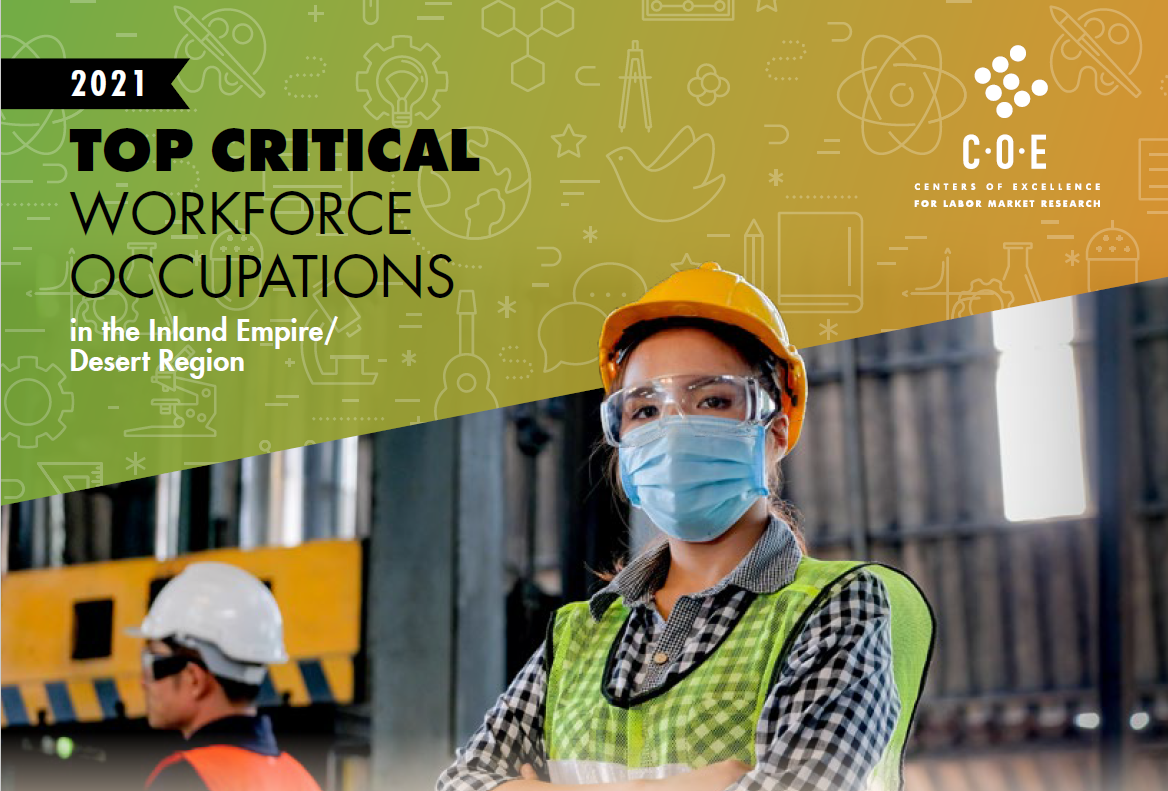
    2021 Top Critical Workforce Occupations in the Region

    A recent report from our Partners at the Centers of Excellence for Labor Market Research at Chaffey College focuses on occupations that address the region’s critical health, safety, and economic needs and are expected to remain in-demand despite the ongoing pandemic. These occupations are further categorized by their typical education requirement, projected annual job openings, and if they provide self-sustainable hourly earnings.

    To view other studies and learn more about regional labor market research please visit http://www.coeccc.net.

    twitterfacebookinstagramyoutubelinkedin
  • GIA Becomes Independent 501c3 Organization

    GIA Becomes Independent 501c3 Organization

    GIA is pleased to report that we have received an official letter of tax-exempt status and have started operating as an independent 501c3 corporation as of January 1, 2021. When GIA was founded in 2015, the Inland Empire Economic Partnership agreed to serve as the fiscal sponsor. In early 2020, the GIA Board determined that it was time to set GIA up as an independent entity. In April, we incorporated in the State of California as Growing Inland Achievement Inc. and proceeded to apply for tax-exempt status.

    This approval recognizes the hard work of the GIA Board and staff over the past five years. It is an acknowledgment of our ability to provide services to our community successfully and to conduct business in a fiscally responsible manner. While this will shift internal operations, to our partners and the community, we will continue to look and feel the same, providing the same level of service and partnership we have for the past five years.

    “We wish to express profound appreciation to the Inland Empire Economic Partnership for serving as our fiscal sponsor over these past five years. IEEP staff has provided immeasurable support to our team as we have gone through this exciting growth process,” said GIA Chief Operating Officer, Ann Marie Sakrekoff.

    twitterfacebookinstagramyoutubelinkedin

  • Ecocycle Mapping Event Recap

    Ecocycle Mapping Event Recap

    On December 2, 2020, Growing Inland Achievement and Collective Impact Forum hosted a training session on Ecocycle Mapping. The concept of an ecocycle draws on biological research into the closed-loop system of development, conservation, destruction, and renewal seen in natural (ecological) systems. The ecocycle suggests that the long-term sustainability of adaptive organizations and initiatives requires that elements of those organizations undergo systematic processes of destruction and renewal.

    Participants explored the process of plotting an organization’s various programs, initiatives, and efforts onto the ecocycle framework to visualize how resources and energy are distributed across different phases of the ecocycle. The concept has proven to be valuable for those managing a broad portfolio of programs and overseeing complex initiatives such as collective impact work.

    For those unable to attend, or seeking a refresher on the workshop content, you may find the Zoom recording of the meeting and supplemental documents linked below.

    Zoom Recording

    Watch the recording of the Ecocycle Mapping Workshop.

    Meeting Documents

    View the presentation slide deck and workshop handout.

    twitterfacebookinstagramyoutubelinkedin