Author: Growing Inland Achievement

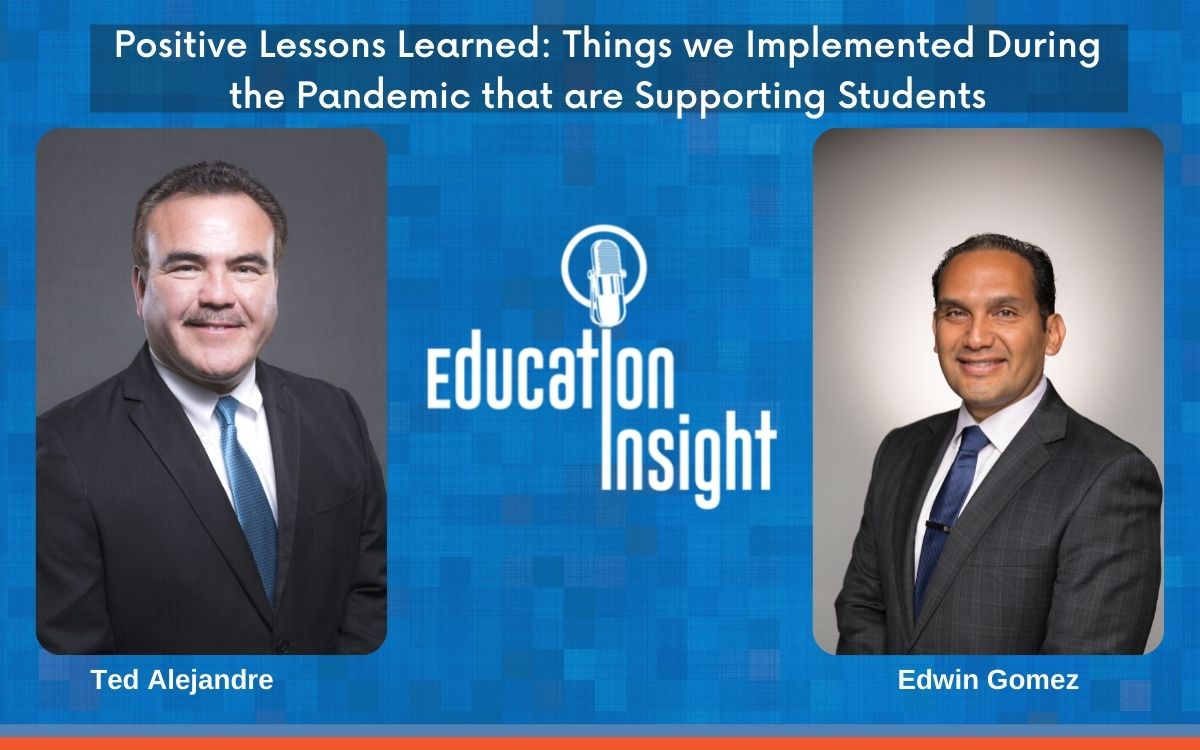
  • Education Insight: Positive Lessons Learned: Things we Implemented During the Pandemic that are Supporting Students

    Education Insight: Positive Lessons Learned: Things we Implemented During the Pandemic that are Supporting Students

    About This Episode

    Season 1. Episode 3.

    Taking our education system entirely online within a month would have seemed to be an impossible task before the pandemic. Yet, schools across the region made it happen to ensure learning continued despite the challenges faced during the crisis.

    Many of us were surprised at the things we learned. Now, with a glimmer of normalcy on the horizon, and state and national resources dedicated to accelerating out of the pandemic, what are the positive takeaways from this experience? Join us for a discussion with three special guests about using lessons learned to improve student access and success.

    Featured Guests

    Ted Alejandre

    San Bernardino County Superintendent of Schools.

    Emma Diaz has more than 30 years of experience in the fields of healthcare and education. She is currently the Director for the Inland Adult Education Consortium at San Bernardino Valley College, where she manages the implementation of the California Adult Education Program (CAEP) legislation. As Director she has played a leadership role in creating and expanding educational programs across the region for underserved, often marginalized populations in adult education.

    Emma participates regularly on state level advisory groups, presents at regional, state and national conferences, and is an international lecturer. She strategically positioned the Inland Adult Education Consortium as the professional development center for the Inland Empire, partnering with both state and national organizations. Most recently hosting the 2nd Annual Google Summit for Adult Education.

    In addition to her current role as Consortium Director, she teaches for both credit and noncredit programs at multiple community colleges. She is currently a Board Member of the Association of Continuing and Community Education and is on the Basic Skills and Noncredit Committee for the Academic Senate for California Community Colleges. She earned her Ed.D. in Educational Leadership from the University of Southern California, holds a master’s degree in Healthcare Administration and a bachelor’s in Business Administration from California State University, Northridge.

    Edwin Gomez

    Riverside County Superintendent of Schools.

    Annette Webb, M.Ed., is the Associate Dean of Academic Affairs at the University of California Riverside, University Extension. In her role, Annette upholds University Extension’s preeminent status in the professional, online, and continuing studies realm by evaluating and successfully responding to the educational needs of non-traditional learners, both domestic and international. She provides leadership in curricular and instructional areas, strategic planning, partnership engagement, student success, academic quality, and financial management.

    Annette is a product of the California Master Plan for Higher Education, beginning her educational journey at Crafton Hills Community College then transferring to California State University, San Bernardino to earn a Bachelor’s degree in Business Administration. She went on to complete a Master’s degree in Education with an emphasis on Higher Education Leadership and Policy from UC Riverside.

    She is a member of Growing Inland Achievement’s Returning Adult Action Network Team and she is the inaugural Co-Chair and Staff Representative for the Chancellor’s Advisory Committee on the Status of Women at UCR. Annette is a proponent for life-long learning and is a higher education professional who represents excellence, accountability, integrity, and respect.

    Interview Highlights

    4:14 – Ted explains how San Bernardino County is geographically very diverse which sometimes complicates the struggle to keep kids learning.

    6:36 – Ted describes what was done by the district to ensure that learning continued even amidst unprecedented learning conditions.

    13:25 – Ted reveals that many administrators including himself, have learned valuable lessons that might actually make local schools better in the long run.

    15:14 – Ted discusses how his district has offered support for mental health issues when it comes to students.

    19:27 – Ted shares how the pandemic has changed the way he views K-12 education in the Inland Empire.

    21:33 – Edwin reveals where his office had made the greatest changes for Riverside County schools.

    24:40 – Edwin shares what he found to be the most difficult thing that his team in the superintendent’s office had to address.

    30:03 – Edwin talks about new projects, initiatives, that have started as a result of the pandemic.

    35:45 – Edwin shares his concerns for the students that lost their senior year of high school and what his office is doing to address their struggles.

    42:40 – Special Feature: Richard Edwards

    View our podcast page for more stories like this: https://gia.echofactory.dev/gia-podcasts/

    Education Insight tells the story of education in the Inland Empire through the diverse voices of those in and around the regional education community. The show is produced by Growing Inland Achievement, a collective impact organization in the Inland Empire with a mission to increase economic prosperity in the region by increasing educational attainment. Hosted by 30-year broadcast veteran Lacey Kendall, monthly shows explore topics ranging from education challenges and shortcomings to innovations and groundbreaking ideas that are driving student success.

  • The State of Latino Education in the Inland Empire

    The State of Latino Education in the Inland Empire

    Did you know that 33 out of 100 Latino adults (25+) in the Inland Empire have not attained a high school degree. That is just one of several key findings GIA President & CEO, Dr. Carlos Ayala, shares in his presentation on The State of Latino Education in the Inland Empire.

  • Education Insight: Achieving Equity at Inland Empire Educational Institutions

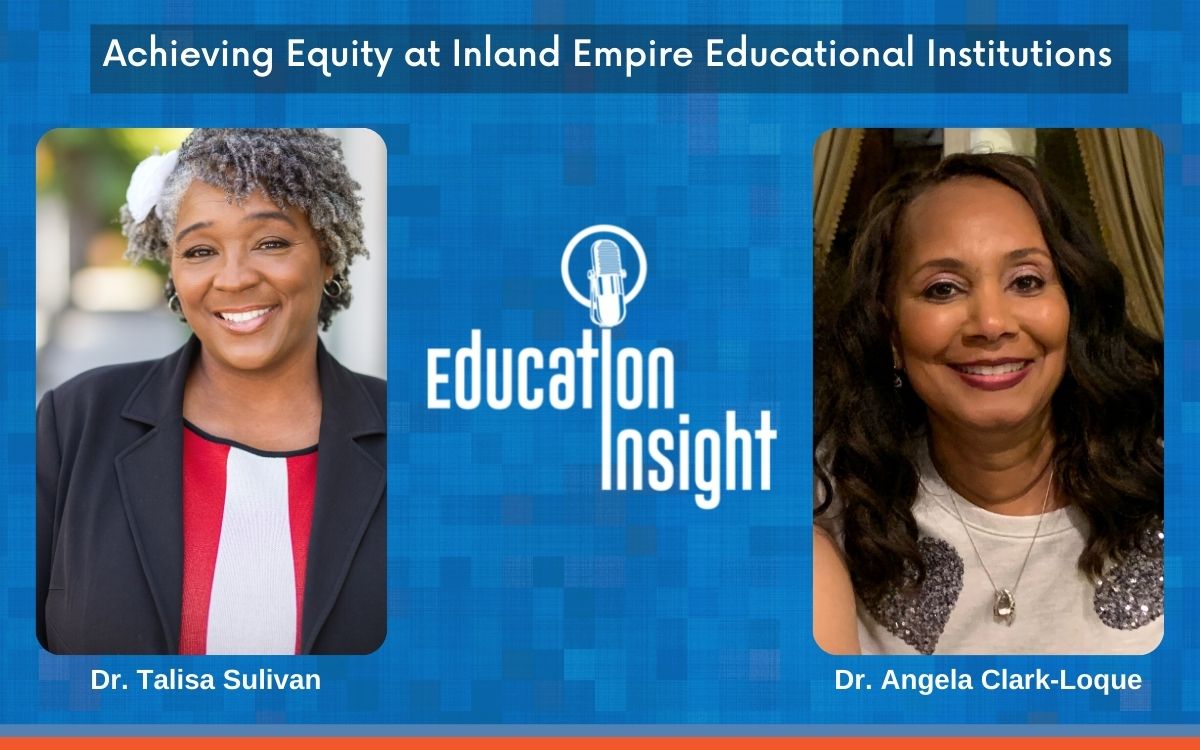
    Education Insight: Achieving Equity at Inland Empire Educational Institutions

    About This Episode

    Season 1. Episode 2.

    In this episode, we explore equity challenges and opportunities at our Inland Empire educational institutions. 

    Featured Guests

    Dr. Talisa Sulivan

    Administrator for Equity and Access for the Riverside County Office of Education.

    Emma Diaz has more than 30 years of experience in the fields of healthcare and education. She is currently the Director for the Inland Adult Education Consortium at San Bernardino Valley College, where she manages the implementation of the California Adult Education Program (CAEP) legislation. As Director she has played a leadership role in creating and expanding educational programs across the region for underserved, often marginalized populations in adult education.

    Emma participates regularly on state level advisory groups, presents at regional, state and national conferences, and is an international lecturer. She strategically positioned the Inland Adult Education Consortium as the professional development center for the Inland Empire, partnering with both state and national organizations. Most recently hosting the 2nd Annual Google Summit for Adult Education.

    In addition to her current role as Consortium Director, she teaches for both credit and noncredit programs at multiple community colleges. She is currently a Board Member of the Association of Continuing and Community Education and is on the Basic Skills and Noncredit Committee for the Academic Senate for California Community Colleges. She earned her Ed.D. in Educational Leadership from the University of Southern California, holds a master’s degree in Healthcare Administration and a bachelor’s in Business Administration from California State University, Northridge.

    Dr. Angela Clark-Loque

    Professor of Educational Leadership at CSU San Bernardino

    Annette Webb, M.Ed., is the Associate Dean of Academic Affairs at the University of California Riverside, University Extension. In her role, Annette upholds University Extension’s preeminent status in the professional, online, and continuing studies realm by evaluating and successfully responding to the educational needs of non-traditional learners, both domestic and international. She provides leadership in curricular and instructional areas, strategic planning, partnership engagement, student success, academic quality, and financial management.

    Annette is a product of the California Master Plan for Higher Education, beginning her educational journey at Crafton Hills Community College then transferring to California State University, San Bernardino to earn a Bachelor’s degree in Business Administration. She went on to complete a Master’s degree in Education with an emphasis on Higher Education Leadership and Policy from UC Riverside.

    She is a member of Growing Inland Achievement’s Returning Adult Action Network Team and she is the inaugural Co-Chair and Staff Representative for the Chancellor’s Advisory Committee on the Status of Women at UCR. Annette is a proponent for life-long learning and is a higher education professional who represents excellence, accountability, integrity, and respect.

    Interview Highlights

    1:55 – Dr. Talisa explains what equity is in education.

    3:30 – Dr. Talisa describes what she handles in her role as Administrator for Equity and Access.

    5:47 – Dr. Talisa shares how one can move from being simply equity-minded to being an equity practitioner.

    10:20 – Dr. Talisa discusses how a school knows when they have truly created a program that has equity.

    13:19 – Dr. Talisa tells us why she believes it’s so important to acknowledge the significance of the experiences of Black, Indigenous, and other people of color versus white people.

    19:43 – Dr. Talisa shares what she feels teachers need to hear the most right now as it relates to equity.

    22:39 – Dr. Angela describes some of the major barriers to the educational success of students here in the Inland Empire.

    24:22 – Dr. Angela shares some specific ways she believes we can move from the equity talk to the equity walk.

    28:17 – Dr. Angela reflects on what she thinks the obstacles are that back racial equity in our schools.

    31:58 – Dr. Angela explains signals to look out for to know when equity practices are working (or not working).

    35:29 – Dr. Angela explains what the term “disaggregation” means and why it has become so important to finding equity in our schools.

    View our podcast page for more stories like this: https://gia.echofactory.dev/gia-podcasts/

    Education Insight tells the story of education in the Inland Empire through the diverse voices of those in and around the regional education community. The show is produced by Growing Inland Achievement, a collective impact organization in the Inland Empire with a mission to increase economic prosperity in the region by increasing educational attainment. Hosted by 30-year broadcast veteran Lacey Kendall, monthly shows explore topics ranging from education challenges and shortcomings to innovations and groundbreaking ideas that are driving student success.

  • Returning Adult Transition Coach Program to be established with support from Bank of America Foundation Grant

    Returning Adult Transition Coach Program to be established with support from Bank of America Foundation Grant

    Adult learners (ages 25+) in the Inland Empire will soon benefit from a new Transition Coach Program developed by GIA and the Returning Adult and Professional Education Action Network Team (ANT). The Bank of America Foundation provided a $40K grant to support the development of the program.

    “Growing Inland Achievement is grateful to the Bank of America Foundation for its ongoing partnership and commitment to helping adult learners in the Inland Empire region,” said Ann Marie Sakrekoff, COO at GIA.

    The Bank of America Foundation’s commitment to raising the educational and economic outlook of the Inland Empire has supported GIA’s work with returning adults since 2019.  As a result, GIA has established an Adult Learner Action Network Team that is coordinating efforts among education leaders and workforce partners to help adults in the region increase their education levels.

    The new Transition Coach Program will support Inland Empire adults 25 years and older who have obtained some college but do not hold a degree or certificate.

    “Navigating the higher education system is complex and having dedicated coaches to support student transition is key to student success,” said Emma Diaz, Ed.D., Director, California Adult Education Program, Inland Adult Education Consortium.

    According to 2017 census data available on GIA’s Data Dashboard, Inland Empire residents with a Bachelor’s degree earn $24K dollars more on average each year than those with only a high school diploma.

    “We have a large number of adults who have some postsecondary credits and may be closer than they realize to earning a degree or certificate,” said Dr. Carlos Ayala, President, and CEO at GIA. “Our goal with these transition coaches is to make the process of returning to college as simple and straightforward as possible.”

    Transition coaches will help individuals identify a career path, enroll in the right classes, apply for financial aid, and link them to additional resources such as childcare, transportation, mental health, or other resources that will support them in completing their education.

    Planning for the new program is currently underway and additional details will be published through GIA’s website and communication channels.

    twitterfacebookinstagramyoutubelinkedin

  • New GIA Data Dashboard Helps to Understand Degrees and Certificates Completed at Inland Empire Community Colleges

    New GIA Data Dashboard Helps to Understand Degrees and Certificates Completed at Inland Empire Community Colleges

    Growing Inland Achievement recently launched a new public Tableau dashboard designed to help users explore community college degree and certificate completion patterns across the region. The dashboard draws from the Integrated Postsecondary Education Data System (IPEDS), a primary source for public information on U.S. colleges, universities, and technical and vocational institutions.

    The Tableau tool was officially launched during GIA’s recent Inland Empire/Desert Guided Pathways Summit in a workshop session titled Designing with the End in Mind: Building equitable guided pathways to living wage jobs in the Inland Empire, co-presented with Rachel Antrobus from WestEd. A video recording of the session, which includes an introduction to the dashboard, is available to watch below.

    “We hope the new dashboard will assist our regional community colleges to identify patterns of degree completion that could be of interest or concern. Is representation across different areas of study proportionate among student subgroups? Are some students underrepresented in higher opportunity programs? For instance, are Black students underrepresented in areas of study that are more likely to lead to better paying occupations or educational pathways?” said Dr. Sorrel Stielstra, Director of Research at GIA. “Along with other resources, such as those provided by WestEd, this tool is ultimately intended to help colleges connect students to equitable pathways to further education and living wage jobs.” 

    For questions about using the Tableau dashboard, reach out to Sorrel Stielstra at sorrel@gia.echofactory.dev.

    twitterfacebookinstagramyoutubelinkedin