The office overseeing the Regional K-16 Education Collaboratives Grant Program will be hosting a live webinar on February 25, 2022, at 10:30 a.m. Several participants from the Inland Empire K-16 Education Collaborative (GIA, IEGO, IECF, etc.) will be in attendance to bring details back to Inland Empire stakeholders in a regional debrief meeting at 1:00 p.m. the same day. However, all interested parties are encouraged to participate in the OPSC webinar as well.
The webinar will include an overview of the grant opportunity, including a Phase 1 round this spring for mature existing collaboratives and a later Phase 2 round of planning and implementation grants for collaboratives in earlier development stages. The webinar will also describe the legal requirements for this program and provide an opportunity for stakeholders and potential applicants to ask questions and share ideas.
Date: Feb. 25, 2022
Time: 10:30 a.m. – 12:00 p.m. (PT)
Registration: Please register for the OPSC webinar here.
* Register for the regional debrief and discussion (1:00 p.m. the same day) here.
Established in the 2021 Budget Act, this program is part of a statewide strategy for both strengthening education-to-workforce pathways and ensuring that education, vocational, and workforce programs work in partnership to address the income, racial, and gender inequalities in education and employment.
This one-time $250 million investment will fund robust regional collaboratives involving K-12 districts, community colleges, state universities, and workforce development entities.
Learn more about local efforts to work together and collaborate on a united Inland Empire grant application.
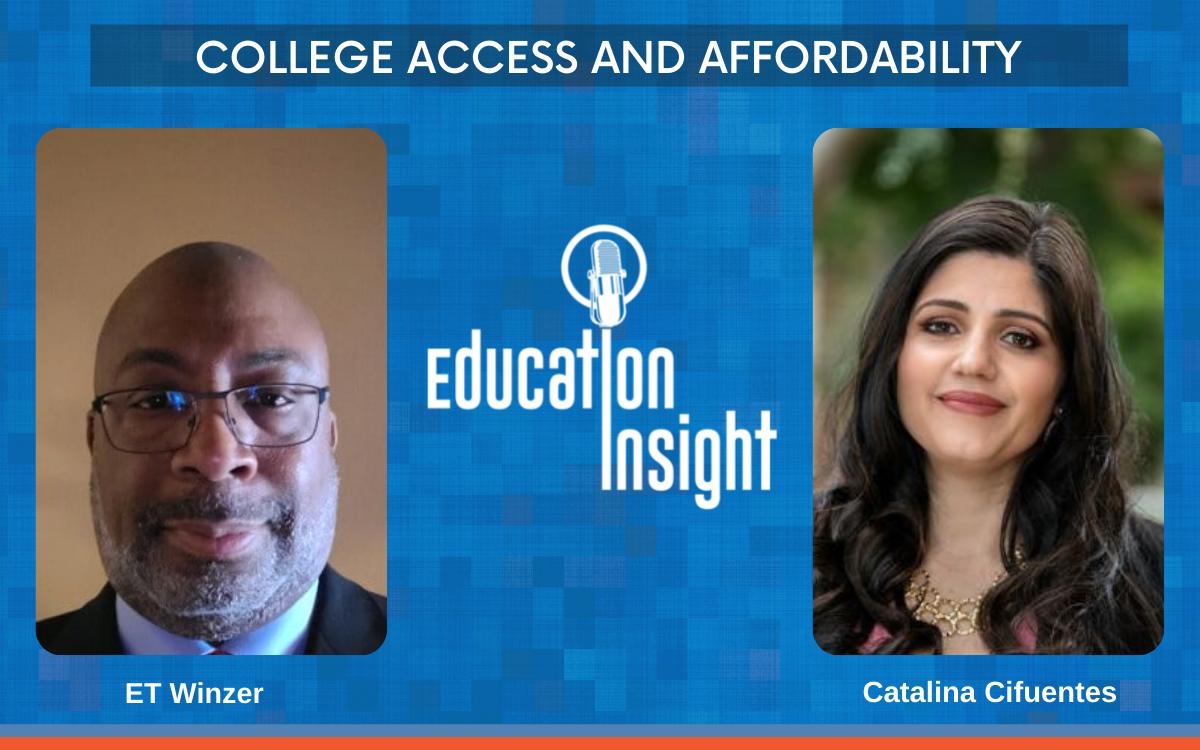
In this episode we learn about college affordability and access and gain a better understanding of student grants, loans and the billions that are available right now for students from all backgrounds to use for college. And, what’s being done to make the process easier to apply, and make college affordable and accessible for residents of our region.
Our guests include Catalina Cifuentes; an expert in College and Career Readiness, for Riverside County’s Office of Education, and the Chair of the California Student Aid Commission. And, ET Winzer, Director of Strategic Outreach and Engagement at Federal Student Aid–an Office of the U.S. Department of Education.
Featured Guests
ET Winzer
Director and Strategic Outreach and Engagement at Federal Student Aid (FSA), and Office of the U.S. Department of Education.
Director, Strategic Outreach and Engagement at Federal Student Aid (FSA), an Office of the U.S. Department of Education
Collaborates across Federal Student Aid, the US Department of Education, other federal agencies, and with industry experts to develop and execute innovative solutions. Develops partnerships and initiatives to equip students and families with the tools to make sensible post-secondary education decisions. Identifies business and industry best practices to improve Federal Student Aid performance. Utilizes relationships with stakeholders and organizations in the education space to improve student success.
Catalina Cifuentes
Executive Director, College and Career Readiness, Riverside County Office of Education.
Catalina Cifuentes is an educator who has demonstrated a gift for counseling and advocacy on behalf of all students.
In her former position as lead counselor at Santiago High School, Corona- Norco Unified School District, Catalina worked with the counseling team to design a successful guidance program which led to Riverside County as well as California Department of Education recognitions for exemplary counseling practices. She worked with her administrative team and staff to transform the school by raising the academic rigor and expectations from students resulting in the highest graduation rate and second highest A-G completion rate in Riverside, Inyo, Mono and San Bernardino County.
Catalina now shares those best counseling practices across Riverside County as the Executive Director of College and Career Readiness in the Riverside County Office of Education. Catalina focuses her work on the Riverside County Office of Education’s Pledge: “All students will graduate from high school well prepared for college or the workforce.” She is also a former secondary Language Arts teacher and has extensive experience working with English Learner programs.
She was selected in November 2014 as a speaker for the College Opportunity White House Convening- Strengthening School Counseling and College Advising. As a former Advancement Via Individual Determination student and first-generation college graduate, Catalina has a passion for this work and it is contagious.
Interview Highlights
3:17 – ET explains what FAFSA is and how it pertains to student aid.
5:22 – ET shares some ways they are simplifying and modernizing the FAFSA programs in order to make it more accessible and beneficial to students and their families.
7:08 – ET explains how the federal student aid office determines who is eligible for financial assistance.
13:42 – ET details recent laws that have been implemented that are designed to simplify the application process
15:23 – ET gives advice to students who are considering taking out a loan to pay for their education
21:52 – Catalina explains the impacts of Governor Newsom’s recent signing of legislation to approve college affordability and increase access to higher education
27:42 – Catalina gives insight to areas we need the most improvement on
31:31 – Catalina details how many students in the Inland Empire actually complete the FAFSA
35:11 – Catalina shares what we can do in the Inland Empire to increase FAFSA completion rates
37:07 – Catalina reflects on how many students think college is simply out of reach financially.
Education Insight tells the story of education in the Inland Empire through the diverse voices of those in and around the regional education community. The show is produced by Growing Inland Achievement, a collective impact organization in the Inland Empire with a mission to increase economic prosperity in the region by increasing educational attainment. Hosted by 30-year broadcast veteran Lacey Kendall, monthly shows explore topics ranging from education challenges and shortcomings to innovations and groundbreaking ideas that are driving student success.
Watch the Video Recording or Listen to the Audio Podcast Below
Full Video Recording
Audio Podcast
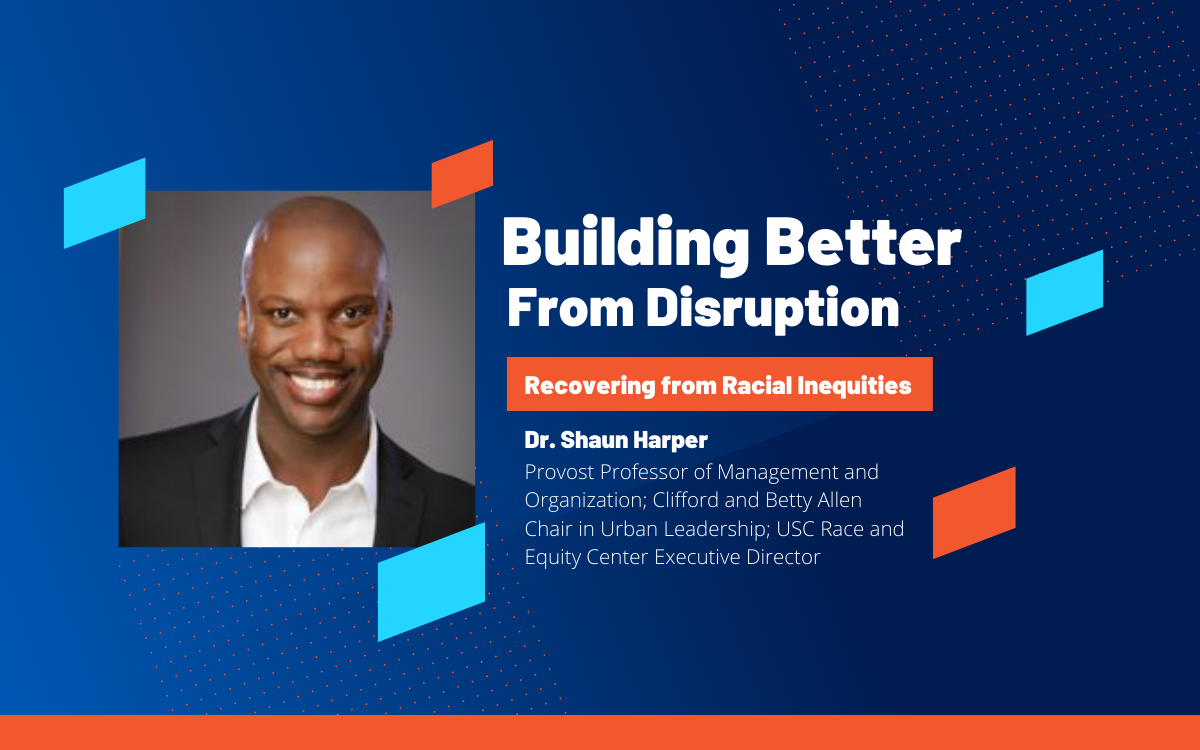
In this session, Dr. Shaun Harper shares practical tips and tools for achieving equity in education.
Keynote Speaker: Provost Professor of Management and Organization; Clifford and Betty Allen Chair in Urban Leadership; USC Race and Equity Center Executive Director.
Session Resources
00:38:51 Gregory Anderson: Good afternoon from Riverside City College! 00:39:49 Jacquelyn Miller-Temecula Valley Unified: Hello from Temecula Valley Unified ? 00:42:11 Carlos Ayala: Welcome RCC. 00:42:22 Carlos Ayala: Welcome Temecula Valley. 00:45:07 Carlos Ayala: Pidgeon Hole? 00:45:53 Ann Marie Sakrekoff: I’ll add it in the chat 00:46:04 Cynthia Glover Woods: Thank you. 00:46:53 Dr. Shaun Harper (he/him): https://uscrec.info/precovid 00:47:18 Dr. Shaun Harper (he/him): https://uscrec.info/precovid 00:48:38 Ann Marie Sakrekoff: To ask questions of Dr. Harper, please go to https://pigeonhole.at/UT2395 01:00:05 Fátima (she/her/ella): Will this recording be available for us to share? I have an entire team of staff who needs to hear this from Dr. Harper. 01:00:34 Yvette Hayes: ^^^ 01:00:56 Carlos Ayala: Yes Fatima. It will be on our website. 01:01:22 Fátima (she/her/ella): Thank you ?? 01:01:48 Woods, Kristi: The charge is so important, though!!! 01:03:06 Minerva Flores: And the equity plans submitted are not focused on changing institutional or practitioner practices. And it always has race neutral language 01:03:24 Yvette Hayes: ^^^ that part 01:06:50 Carlos Ayala: To ask questions of Dr. Harper, please go to https://pigeonhole.at/UT2395 01:13:21 Jacquelyn Miller-Temecula Valley Unified: I printed this report this morning! 01:13:36 Carlos Ayala: Very important document. Great ideas and focus areas. 01:20:12 Carlos Ayala: The community colleges are currently working on their equity plans. 01:23:53 Dr. Shaun Harper (he/him): https://race.usc.edu/2021/12/09/deep-engagement-in-los-angeles-and-inglewood-k-12-schools/ 01:32:15 Ann Marie Sakrekoff: To ask questions of Dr. Harper, please go to https://pigeonhole.at/UT2395 01:40:35 Ann Marie Sakrekoff: MESCal (Math Equity in Southern California) https://www.mescal.info/ 02:03:17 Jackie Melendez: Excellent question, Carlos! IEGO is excited to partner with GIA on this critical regional effort. 02:03:59 Jacquelyn Miller-Temecula Valley Unified: Mr. Ayala, please keep me informed on the “Teach Me The Truth” campaign. GIA is a valuable resource for me. Thank you. 02:07:13 Carlos Ayala: https://gia.echofactory.dev/k-16-education-collaborative/ 02:08:02 Jacquelyn Miller-Temecula Valley Unified: I have registered for this meeting. 02:08:18 Carlos Ayala: Great Jacquelyn. See you there. 02:08:21 Ann Marie Sakrekoff: Please help us to continue great content by taking our survey: https://corexmscjvtwdqg9rjdq.qualtrics.com/jfe/form/SV_6sagYvoJjJTJVv8 02:08:35 Carlos Ayala: We want Temecula to be fully engaged in this work. 02:09:27 Jacquelyn Miller-Temecula Valley Unified: So do I. I am trying….. 02:10:15 Carlos Ayala: Please connect with me directly. Carlos@gia.echofactory.dev I want to follow up with you directly. 02:11:19 Dr. Shaun Harper (he/him): https://time.com/race-in-the-workplace/ 02:12:34 Jacquelyn Miller-Temecula Valley Unified: Carlos, will do. 02:12:49 Jacquelyn Miller-Temecula Valley Unified: YES!!! 02:14:35 Ann Marie Sakrekoff: Please help us to continue great content by taking our survey: https://corexmscjvtwdqg9rjdq.qualtrics.com/jfe/form/SV_6sagYvoJjJTJVv8 02:15:32 Dr. Shaun Harper (he/him): https://race.usc.edu/ 02:17:56 Jacquelyn Miller-Temecula Valley Unified: Thank you!!
Building Better from Disruption is a virtual series designed to build upon lessons learned from districts’ responses to the impact the COVID-19 pandemic has had on schools and school systems. This series is designed to provide education partners, particularly administrators and teacher leaders working at the school site level, with best practices and resources that support students’ successful return to in-person instruction. This five-part virtual series will focus on the essential areas of social-emotional learning, accelerated learning, and community partnerships. During each session, participants will have the opportunity to learn, connect, and interact with expert practitioners and session participants. Support for Building Better from Disruption provided by the William & Flora Hewlett Foundation.
When considering the concept of gathering authentic student voice and input realize that in the long run it is a net benefit. Even if it is difficult to hear or guided by incomplete information, it will inform your decisions and point you to areas of need. Remember, they are often having these conversations whether you hear it or not.
Watch the Video Recording or Listen to the Audio Podcast Below
Session Resources
About the Session
In this session, educators engage in educational equity work by taking a deep dive into concepts that support the development of an authentic commitment to redefining student success with an equity lens. Participants learn how to move from theory to practice through utilizing numerous tools for practical application and facilitation of equity work. Content focuses on mindsets and beliefs while creating a parallel between adaptive and technical work in the school system to interrupt inequitable practices and close equity gaps for marginalized student groups. Topics and outcomes include:
Develop common language, define equity, diversity, and inclusion to guide facilitation of conversations and the work
Develop an understanding of research around the 4 indicators of equity to address instructional practices and academic achievement
Develop an understanding of collecting, analyzing, and monitoring qualitative and quantitative data to drive equity work in the classroom
Recognize and respond to the barriers to equity and cultural proficiency (i.e. history of public education, implicit bias, stereotypes, and institutional racism)
Reflect on the role of educators in perpetuating or ending educational gaps
Understand a system’s approach to interrupting patterns of inequities within the school system
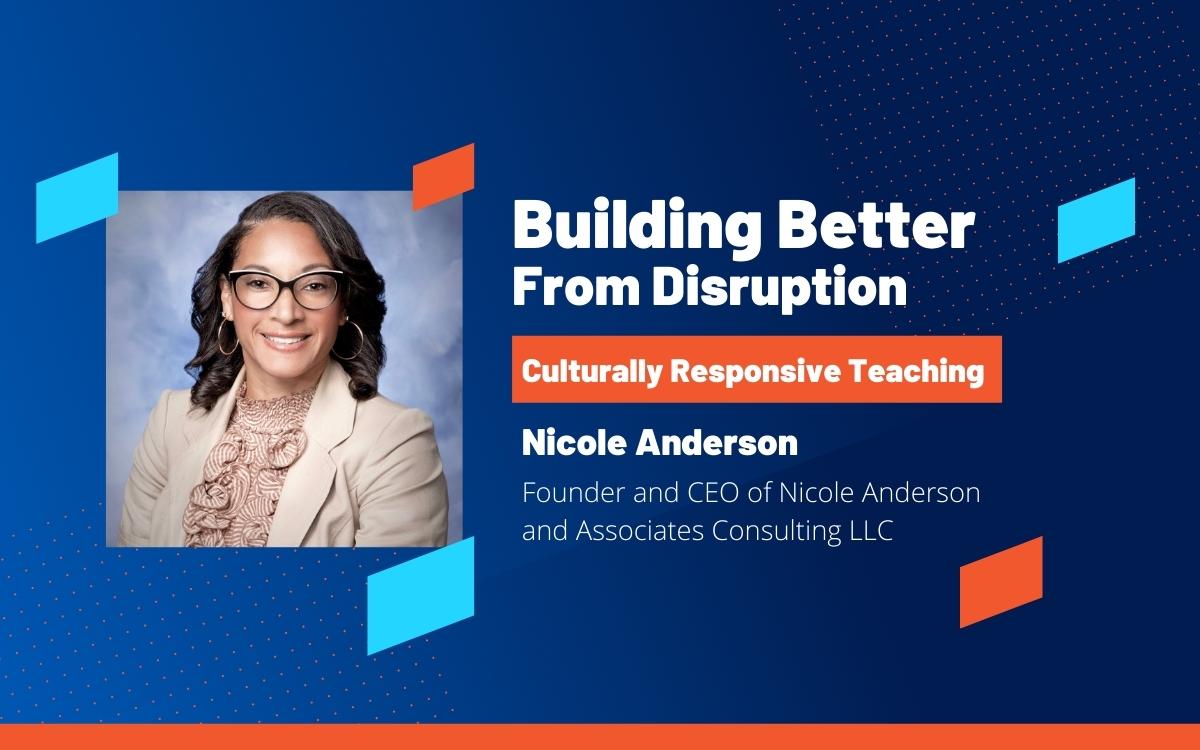
Keynote Speaker Dr. Nicole Anderson, Founder and CEO of Nicole Anderson and Associates Consulting LLC
Building Better from Disruption is a virtual series designed to build upon lessons learned from districts’ responses to the impact the COVID-19 pandemic has had on schools and school systems. This series is designed to provide education partners, particularly administrators and teacher leaders working at the school site level, with best practices and resources that support students’ successful return to in-person instruction. This five-part virtual series will focus on the essential areas of social-emotional learning, accelerated learning, and community partnerships. During each session, participants will have the opportunity to learn, connect, and interact with expert practitioners and session participants. Support for Building Better from Disruption provided by the William & Flora Hewlett Foundation.
When considering the concept of gathering authentic student voice and input realize that in the long run it is a net benefit. Even if it is difficult to hear or guided by incomplete information, it will inform your decisions and point you to areas of need. Remember, they are often having these conversations whether you hear it or not.
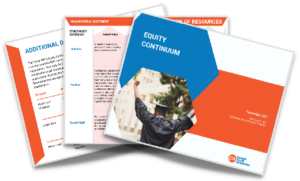
The tool is designed to support educational institutions in examining their current organizational cultures and structures.
Growing Inland Achievement’s regional Equity Action Network Team (ANT) recently published a new Equity Continuum tool available for educational institutions and organizations to download now. The Equity Continuum is a formative assessment framework that fosters reflection on the experiences of key parties in the education system – students, faculty, staff, administration, and the overall organization. These experiences are considered on several dimensions including, communication efforts, institutional policy, culture, and physical spaces.
GIA believes widespread adoption and feedback will help improve the Equity Continuum while providing users the ability to assess, strengthen, and implement equity strategies over time. “This tool will continue to improve as we harness the collective intelligence of the communities that put it to use,” said Dr. Carlos Ayala, President & CEO at GIA. “Imagine after ten iterations—even 100—how many institutional equity dimensions and corresponding equity improvement steps can be discovered, designed, and developed. This is very exciting.”
Several local organizations have already committed to beta testing the tool. GIA hopes that many more will be early adopters and share insights on what they learn in the process.
Growing Inland Achievement (GIA) is a regional, collective impact organization that works to achieve educational and economic equity in the Inland Empire. GIA accomplishes this by serving as a collective impact (backbone) organization that supports a cross-sector network of education, government, nonprofit, and business institutions in the Inland Empire, all collectively working towards a shared vision of educational and economic success. GIA researches issues and opportunities, resources innovations and solutions, and connects diverse stakeholders across the two-county region of the Inland Empire. Learn more at inlandempiregia.org.