In this podcast, Dr. Louie Rodriguez, Interim Dean and Professor, UCR School of Education, talks about their FIERCE Scholars Program and the impact he expects it to have on the teacher and educator workforce in the Inland Empire.
The Inland Empire Enrollment and Persistence Study aims to understand experiences of young adults in the Inland Empire who had planned/hoped to complete college but did not.
Why is it important?
Young adults’ obstacles to achievement are not well understood and the pandemic has both compounded the difficulty and reinforced the importance of learning about their experiences. Reaching them and learning first-hand about their experiences allows us to identify regional educational support to decrease barriers and increase opportunities for them to meet their hopes/plans.
00:13:44 Michael Wiafe: I would like to note than Jennifer coined the term “dream team k-16” I love it. Good morning folks! 00:14:22 Dean Gerstein: Good morning all! 00:16:28 JACQUELINE MELENDEZ: Good morning! Nice slide deck, Carlos! 00:17:27 Laurie Schoelkopf: https://inlandempiregia.sharepoint.com/:w:/r/sites/GIATogether/_layouts/15/Doc.aspx?sourcedoc=%7BBAF00174-EB30-4F34-A089-23E818D63E8B%7D&file=Pathways%20Framework_detail.docx&action=default&mobileredirect=true 00:18:31 Hend Gilli-Elewy: @Laurie, the link is not working for me 00:18:37 Stephanie Murillo: The link didn’t work for me. Are others having the same issue? 00:18:53 Dean Gerstein: Yes. requires an earlier registraton 00:18:54 Maral Hernandez: same. it’s not working. 00:18:59 Becky Sumbera: Same here 00:19:16 James Spee: Sharepoint does not play well with accents outside the organization creating it. 00:19:32 Michael Wangler: Try this: https://inlandempiregia.sharepoint.com/:w:/s/GIATogether/EXQB8Low6zRPoIkj6BjWPosBcFc6-tbhEG9rxKgJP1xh8g?e=BdSTm8 00:19:50 James Spee: That worked! 00:19:51 Becky Sumbera: That wored 00:19:54 Stephanie Murillo: That one worked. Thank you, Michael 00:20:47 James Spee: What is the status of the Steering Committee? 00:21:13 Laurie Schoelkopf: Agenda and discussion questions for breakout rooms: https://inlandempiregia.sharepoint.com/:w:/s/GIATogether/EZknGo5fmdNKu_E6-u98NmIBbrLXy0VW1v0pLc4T2H0IoQ?e=tPSsuh 00:21:47 Stephani Congdon: Just make sure the pathways are all inclusive 00:25:08 Dean Gerstein: So there are pathways that one can directly name in the proposal, for example some articulation agreements from cc to 4-year, but others may be formed on similar models. essentially TBD in the proposal?. 00:26:40 Beth Higbee: Yes, some will be partially formed already, and others will be fully formed. There might be some that are starting absolutely new, but in most spaces there are already multiple efforts underway. 00:29:53 Stephani Congdon: Totally agree with sbccd 00:30:50 Stephanie Murillo: Where is the agenda? 00:31:13 Laurie Schoelkopf: https://gia.echofactory.dev/k-16-education-collaborative/ 01:08:01 Stephani Congdon: Welcome 01:09:20 Dean Gerstein: 2 points: (1) pathways should be cast as directed networks rather than pipelines, because students shift their goals and interests as they learn more about their possibilities; and it should conceived as K=16+ , because a strong modern workforce needs a lot of people with graduate training (credentials, degrees, continuing ed) too 01:09:25 Hend Gilli-Elewy: Thank you! 01:09:56 Ida Hermosillo,GIA: Happy Friday! 01:09:57 Nicole Vega: Thank you!
00:13:31 James Spee: Hola! Buenos Dias! 00:13:33 Beth Higbee: Good Morning, Everyone! Great to see you! 00:14:36 Michael Wangler: https://k16collaborative.org/phase-1-collaborative/ 00:15:00 Chinaka DomNwachukwu: Chinaka DomNwachukwu, CSUSB. Good morning everyone. 00:20:56 James Spee: https://k16collaborative.org/phase-1-collaborative/ 00:20:56 Ida Hermosillo,GIA: https://k16collaborative.org/phase-1-collaborative/ 00:25:30 Stephani Congdon: Unfortunately I I have to leave early for an IE autism and other intellectual abilities mtg Let’s make such we are all inclusive Even other educational institutions such as private and charter schools 00:26:21 carlos ayala: We hear you Stephani. 00:28:19 James Spee: The RFP mentions only 2 pathways for Phase 1 00:30:01 carlos ayala: We are asking more about that James. 00:34:48 Rose Gonzalez – SBCUSD: In the K-12 space, the California Department of Education has recognized 15 industry sectors. Each industry sector is made up of specific pathways. 00:38:46 Becky Sumbera, CSUSB: Thank you! 00:38:50 James Spee: We need a venn diagram that shows how these overlap. 00:39:01 Michael Wiafe: Awesome Jackie! 00:39:03 Ida Hermosillo,GIA: Excellent crash course. Thank you! 00:39:19 Conrad Shayo: Thank you. 00:42:11 Rose Gonzalez – SBCUSD: Thank you! 00:42:12 Michael Goss: Inland Empire/Desert Sector Report: https://coeccc.net/inland-empire-desert/2021/07/sector-analysis-report-high-quality-jobs-in-the-inland-empire-desert/ 00:42:56 Mara Montelongo: Thank you Jacqueline! Great presentation! 00:46:45 JACQUELINE MELENDEZ: Jackie Melendez | IEGO | cell – 909-268-2967 | jmelendeziego@iegives.org 00:47:12 Becky Sumbera, CSUSB: Thank you! 00:47:31 Beth Higbee: Great job, Jackie! 00:48:33 James Spee: Is any one from Loma Linda University in this group? 00:49:16 Ida Hermosillo,GIA: Invitations to LLU and their San Manuel Gateway College (Allied Health Sciences) have been extended. 00:49:22 carlos ayala: There has been no sure if they are here today. 00:49:39 James Spee: They see crucial for the health sector conversation. 00:49:43 James Spee: seem 00:50:27 Sastry Pantula (CSUSB/He, His, Him): CSUSB has an excellent nursing, health science and other programs and is working on a physician assistant program currently. 00:51:19 James Spee: Redlands has a pre-med major, but needs to do more. 00:51:53 Dean Gerstein: Western UHS is in LA County, but most of its students are IE. May also be true of CGU and KGI. All train a lot of mid-level health care workers 00:52:25 Sastry Pantula (CSUSB/He, His, Him): CSUSB also has a large pre-med program that leads to medical, dental, pharma, OT and other programs, and just signed also a partnership with UCR med school for a grant proposal. 00:52:44 Cynthia L Escartin: ACI Learning has accelerated virtual CUSS Programs, and other IT/cyber related programs 00:52:57 Cynthia L Escartin: All of which have ACE recommended college credit 00:53:06 Louie Rodriguez: Michael, this is really helpful. Thank you. 00:53:27 Sorrel Stielstra: Love that resource, Michael! 00:53:41 Michael Wiafe: This is awesome 00:53:44 JACQUELINE MELENDEZ: Thank you everyone. I am very fortunate to serve this region alongside each of you. 00:53:49 Jennifer O’Farrell (She/Hers) Big Brothers Big Sisters: That’s great! 00:53:50 JACQUELINE MELENDEZ: I love this map!!! 00:54:03 Ida Hermosillo,GIA: Inland Empire/Desert Sector Report: https://coeccc.net/inland-empire-desert/2021/07/sector-analysis-report-high-quality-jobs-in-the-inland-empire-desert/ 00:54:15 James Spee: Big difference between Health Sector and the other 3. 18000 jobs!!! 00:54:16 Avila Avila: Nothing in the arts and media? Alex Avila 00:54:29 Avila Avila: Overall great presentation. Alex Avila 00:54:39 Wayne Fletcher: CBU has BSN, MSN, Nurse Practitioner, DNP, PA, SLP, Athletic Training, Rad Tech, PT Assistant and all of the pre-med/pharm/dental etc. 00:54:41 James Spee: Alex, they are not in the RFP. 00:54:47 Becky Sumbera, CSUSB: Thank you Alex! 00:57:00 JACQUELINE MELENDEZ: Posting the report for Michael. https://postsecondarycouncil.ca.gov/initiatives/recovery-with-equity/ 00:57:58 Michael Goss: Career Education Map: https://bit.ly/IECareerMap 00:58:08 carlos ayala: Thank you Michael 00:59:53 carlos ayala: Amazing pathways through out the county. Check out the data from Mr. Goss report. Almost all K-12 have great programs with Community Colleges. We are building from our strengths. 01:00:32 Avila Avila: Carlos you have done a great job facilitating. Brilliant leadership, seamless. Great job Jackie, you knocked it out the park. Alex Avila 01:00:58 James Spee: When you add the high school pathways, the geography gets tougher. CC programs are not always close to the HS programs. 01:02:01 JACQUELINE MELENDEZ: Thank you, Alex!!! 01:02:33 carlos ayala: That is right James. Districts nested in districts. 01:02:33 JACQUELINE MELENDEZ: I have to jump off for my next meeting. ? 01:02:42 carlos ayala: Thank yo Jackie 01:02:47 carlos ayala: you 01:04:10 Becky Sumbera, CSUSB: Can we please get all the presentations sent to us? 01:04:23 Becky Sumbera, CSUSB: I look of great information. 01:04:26 carlos ayala: Yes. We add them to the GIA website 01:06:30 Becky Sumbera, CSUSB: Thank you!! 01:06:32 Avila Avila: The cost of college has gone up over 600% since the Obama era. With inflation and campus expansion how in the world are we supposed to reduce the cost? Alex A 01:06:40 James Spee: We have talked about all of these issues in our working groups. A shared outcome data site would be a great achievement. 01:07:33 Avila Avila: I agree with James. Alex Avila 01:07:54 James Spee: I would like to overcome the barriers to enrolling in higher education in the first place. 01:07:59 Michael Wiafe: https://postsecondarycouncil.ca.gov/ 01:08:09 Avila Avila: Excellent work Wiafe. Alex Avila 01:08:09 Michael Wiafe: Recovery with equity site 01:08:18 Rose Gonzalez – SBCUSD: Thank you! 01:08:23 Michael Wiafe: Thanks Alex! Thank you all 01:08:28 Louie Rodriguez: Thank you 01:08:30 Hend Gilli-Elewy: Thank you Carlos and all presenters! 01:08:35 James Spee: Thanks! 01:08:36 Becky Sumbera, CSUSB: Have a great weekend!!
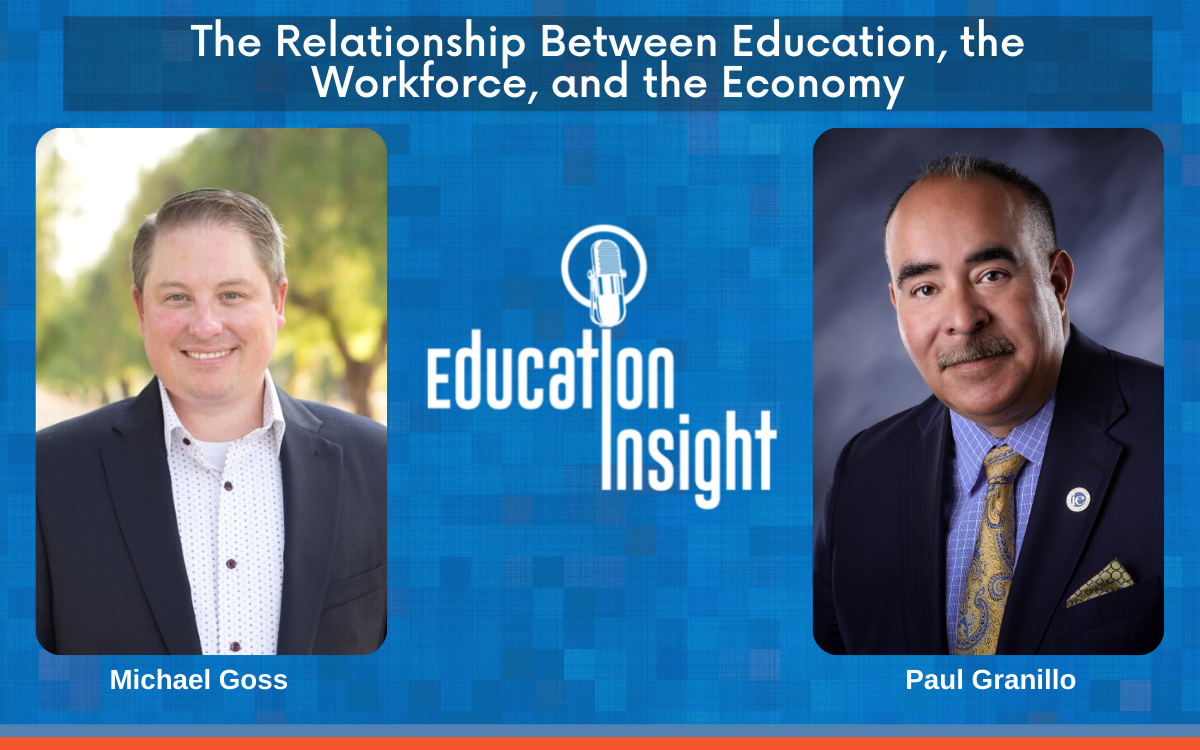
In the 1970s and 80s, traditionalist educators insisted that a great education should include lots of structure, specific standards of performance, and a heavy dose of memorization of key facts and concepts. These they assured, would help our students to enter the workforce already proficient in language and writing skills, mathematics, science, social studies, and some critical thinking. Are those skills enough for an IE student to succeed in the current and coming workforce? What do students in the Inland Empire need to know today? Are our schools preparing graduates with what they really need to know and preparing our community with upcoming graduates ready to take local businesses and industry into a brighter future? Find out in today’s episode.
Featured Guests
Michael Goss
Director of the Inland Empire/Desert Center of Excellence for Labor Market Research
Kevin McCarty was elected to the California State Assembly in 2014 to represent the 7th Assembly District, which includes Sacramento, West Sacramento and parts of unincorporated Sacramento County.
McCarty serves as Chair of the Assembly Budget Subcommittee on Education Finance, which oversees the largest component of California’s multi-billion dollar budget. As Chair, McCarty made historic investments in public education including expanding access to preschool for low and middle income families, providing greater career technical education programs, and increasing student enrollment at our public colleges and universities.
Other legislative priorities for Assemblymember McCarty include addressing housing affordability, fighting climate change, championing criminal justice reform, curbing gun violence, tackling the opioid crisis and advocating for the middle class.
McCarty began his public service career as a Sacramento Housing and Redevelopment Commissioner and served on the Sacramento City Council from 2004 to 2014. As a Councilmember, he created innovative youth programs and wrote common-sense gun laws, tackled sub-standard rental housing, and crafted clean air policies. He created Sacramento’s Little Saigon district, the City’s Whistleblower Hotline program, and the Independent Auditor department.
A lifelong Sacramentan, McCarty went to local public schools, attended American River College, earned a Bachelor’s degree in Political Science from CSU Long Beach and a Master’s degree in Public Policy and Administration from CSU Sacramento.
McCarty and his wife live in the Elmhurst neighborhood of Sacramento with their twin daughters.
Like, follow and connect with Assemblymember McCarty on Facebook, Twitter & Instagram: @AsmKevinMcCarty
Paul Granillo
President & CEO, Inland Empire Economic Partnership (IEEP)
Karen Scott is the Executive Director of the Children and Families Commission – First 5 San Bernardino, a funding organization of services for children prenatal through age 5, by investing revenue received from Prop 10, a tobacco tax initiative in California.
Ms. Scott’s education and background is in Public Administration and Administration of Justice and she has worked in the realm of Human Services for San Bernardino County since 1977. Karen has served as Executive Director of First 5 San Bernardino for 14 years leading the organization’s efforts to promote, support and enhance the health and early development of children, prenatal through age five through coordinated and comprehensive systems of care that strengthen children, families and communities, ensuring children are safe, healthy and ready to enter and succeed in school.
Karen is married to James Scott and has 4 adult children and 4 grandchildren.
Interview Highlights
8:17 – Michael shares the most in-demand careers right now and in the future for the Inland Empire
10:15 – Michael describes how the Inland Empire is doing as a region in keeping up with workforce demand
13:02 – Michael discusses particular industries that he believes are economically critical to the Inland Empire
14:20 – Michael details what we can do as a region to be more competitive going forward
15:12 – Michael talks about some of the most significant challenges that we’re facing in regards to training and meeting the needs of businesses in the region.
18:28 – Michael gives insight into how COVID-19 has changed the workforce in the Inland Empire
23:16 – Paul shares the greatest challenges facing the Inland Empire today
25:36 – Paul describes how the Inland Empire is doing when it comes to training and education of a workforce to meet the needs of employers
26:40 – Paul reflects on the lessons we’ve learned about our local economy as a result of the pandemic.
30:34 – Paul explains what he believes is needed from our workforce and our local educational institutions to create a more vibrant regional economy.
34:37 – Paul shares whether or not he believes education is necessary to earn a living wage in our region
38:46 – Paul discusses whether or not more college graduates = more businesses in the Inland Empire
46:08 – Special Feature Original Song: Romeo by: Micha Justice
Education Insight tells the story of education in the Inland Empire through the diverse voices of those in and around the regional education community. The show is produced by Growing Inland Achievement, a collective impact organization in the Inland Empire with a mission to increase economic prosperity in the region by increasing educational attainment. Hosted by 30-year broadcast veteran Lacey Kendall, monthly shows explore topics ranging from education challenges and shortcomings to innovations and groundbreaking ideas that are driving student success.